

The essential answer
An illustrative difference of 100 units has a standard uncertainty of 1.26 units when its inputs have standard uncertainties of 2 and 1 units and correlation 0.85. Ignoring correlation would give 2.24 units. Positive covariance reduces uncertainty in a difference because shared shifts partly cancel. The same covariance increases uncertainty in a sum. Neither result licenses subtracting uncertainty magnitudes directly or assuming that every shared instrument creates perfect cancellation.
How to reason about it
Define the measurand before combining components. For D=A−B, the sensitivity coefficients are +1 and −1. The linear propagation model is u(D)²=u(A)²+u(B)²−2 cov(A,B), with cov(A,B)=r u(A)u(B). Correlation is a property of the joint uncertainty model, not a reward for using similar equipment. A shared reference may contribute correlated error while independent reading noise remains uncorrelated. If the two readings occur at different times, drift may alter their relationship. A useful budget therefore separates reference, repeatability, and drift components before aggregation. The result is a standard uncertainty, not automatically a confidence interval. A coverage factor requires distributional and degrees-of-freedom assumptions. NIST supplies the propagation principle; the inputs and comparison here are invented teaching values.
ILLUSTRATIVE · NOT A REPORTED RESULT
An example to work through
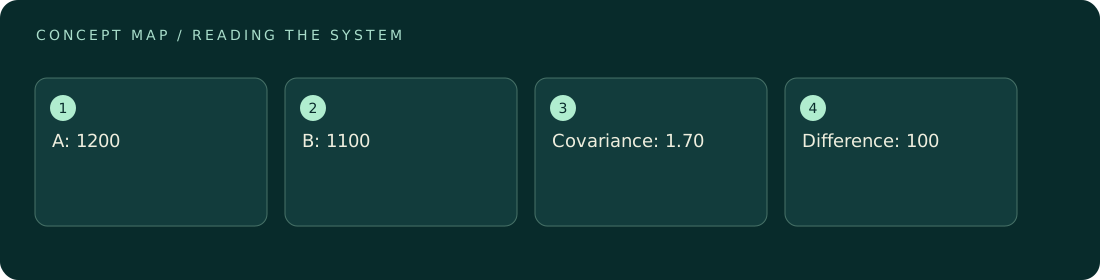
Take illustrative readings A=1200 units and B=1100 units. Their difference is D=1200−1100=100 units. Specify u(A)=2 units, u(B)=1 unit, and r=0.85. The covariance is 0.85×2×1=1.70 units². Therefore u(D)²=4+1−3.40=1.60 units² and u(D)=sqrt(1.60)=1.2649 units, reported here as 1.26 units. Setting r=0 instead gives sqrt(5)=2.2361 units. As a diagnostic, reverse the arithmetic operation: for S=A+B=2300 units, u(S)²=4+1+3.40=8.40 units² and u(S)=2.8983 units. The inputs have not changed; the sensitivity signs have. If a provisional coverage factor k=2 were justified, the difference would have expanded uncertainty 2.53 units. That final operation does not prove 95 percent coverage. Preserve the unrounded values internally, record why the covariance was selected, and distinguish the illustrative numerical result from a calibrated instrument specification.
Where interpretation fails
Estimating correlation from a handful of repeated readings can miss the common calibration component entirely. Repeated observations mainly reveal variation during that run. A stable but uncertain reference can move all readings together without appearing in their short-run scatter. Treating small scatter as a complete uncertainty budget would therefore be misleading.
The next decision
Retain the covariance term only when its origin is documented. If correlation is poorly known, report how the answer changes over a defensible range instead of selecting the value that produces the smallest interval. The immediate learning decision is whether the intended operation is a sum or a difference.
Sources & context
These sources support the concepts noted below. Our synthetic examples and research framing are educational interpretation; they are not findings from these organizations or validation of our ventures.
- NIST TN 1297: Combined Standard Uncertainty ↗
Covariance belongs in uncertainty propagation; recognized systematic effects need correction.
Source check: Relevant sections 5.1–5.2 read
Educational research context, not a validated device specification or clinical protocol. Read our editorial and correction policy.