

The essential answer
Independent replication examines a claim using newly collected evidence with enough separation to reduce relevant shared errors. Independence can involve specimens, operators, apparatus, analysis, or sites, depending on the claim and suspected failure modes. Re-running the same code on the same data is computational reproduction, which is useful but answers a different question. Specify which aspects are intentionally matched and which are varied. Define the target claim and agreement criterion before inspecting the replication outcome so success is not reduced to a vague resemblance.
How to reason about it
A replication should preserve the features essential to the original hypothesis while making the new evidence genuinely informative. Exact procedural copying may retain a hidden calibration error, whereas excessive changes may test a different claim. Document both the common protocol and deliberate differences. Use independent calibration or reference materials when a shared measurement bias is plausible. Decide whether the goal is consistency of effect size, direction, practical performance, or a specified prediction, and account for the expected uncertainty in both studies. Disagreement can reveal limited transferability, uncontrolled conditions, or an original error; it does not identify the cause by itself. A useful comparison includes raw evidence and configuration details sufficient to investigate those possibilities. Replication is strongest as a planned learning exercise that can refine the domain of a claim, rather than a binary contest between laboratories or analysts.
ILLUSTRATIVE · NOT A REPORTED RESULT
An example to work through
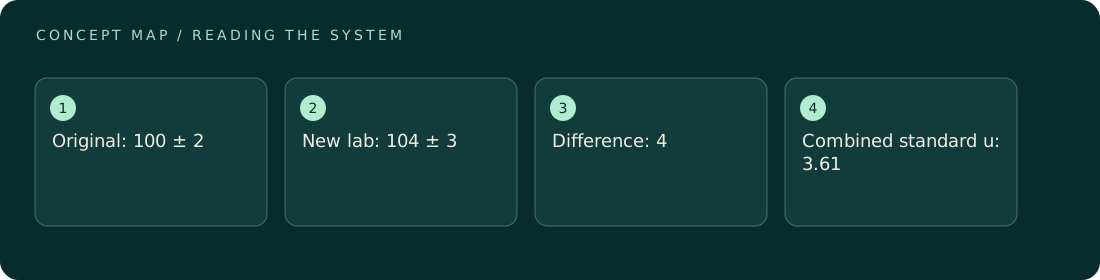
Suppose an original fictional test estimates a stiffness of 100 units with standard uncertainty 2. A separate lab, using new specimens and independently calibrated equipment, estimates 104 with standard uncertainty 3. Assuming the estimates are independent and the uncertainty descriptions are appropriate, the difference is 4 and its standard uncertainty is sqrt(2 squared + 3 squared), about 3.61 units. The difference is therefore about 1.11 combined standard uncertainties. That calculation helps contextualize agreement but is not a universal pass rule. Shared specimen preparation or model assumptions could still limit how independent the two findings really are.
Where interpretation fails
Calling a rerun independent because a different person clicked the same script over the same files overstates the new evidence. Conversely, declaring a replication failed because one study crosses a significance threshold and the other does not ignores effect sizes, precision, and whether the estimates are actually incompatible.
The next decision
Choose independence to target plausible common errors and define the comparison before data collection. Report effect estimates and uncertainty alongside procedural differences. If the results disagree materially, investigate the boundary conditions and measurement chain before broad conclusions; if they agree, state the tested domain rather than claiming universal confirmation.
Sources & context
These sources support the concepts noted below. Our synthetic examples and research framing are educational interpretation; they are not findings from these organizations or validation of our ventures.
- National Academies: Reproducibility and Replicability in Science, Summary ↗
Reproducibility and replication describe distinct forms of evidence.
Source check: Official consensus-report summary opened; not the full book.
Educational research context, not a validated device specification or clinical protocol. Read our editorial and correction policy.