

The essential answer
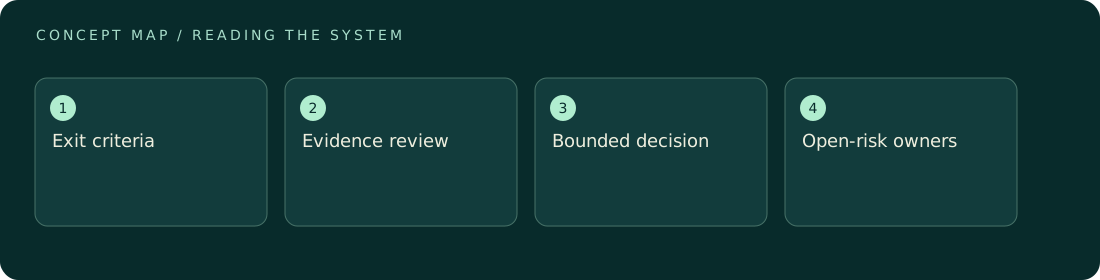
A stage gate is a decision point at which evidence is assessed before committing to the next level of effort, cost, or consequence. Its value comes from clear exit criteria and a real ability to continue, redirect, pause, or stop. A presentation of completed activity is not enough. Identify which uncertainties must be reduced for the next commitment and which can responsibly remain open. Record the decision, evidence, unresolved conditions, and accountable owners so the gate remains meaningful after the meeting.
How to reason about it
Design gates around increasing commitment rather than arbitrary calendar milestones. Before buying long-lead hardware, the relevant evidence might concern interface compatibility and architecture risk. Before an integrated test, it might concern component readiness and test hazards. Before release, it might concern acceptance evidence and operational support. Each gate should distinguish blocking issues from accepted residual risks and explain why. Avoid demanding final-stage certainty too early, because that can consume effort before alternatives have been explored. Conversely, do not let schedule pressure convert an unresolved fundamental question into a cosmetic action item. Conditional progression can be useful when conditions are specific, time bounded, and tied to consequences. The record should make clear whether a team is authorized to proceed fully or only to perform a limited activity that closes the uncertainty. This keeps technical evidence connected to the actual resource decision.
ILLUSTRATIVE · NOT A REPORTED RESULT
An example to work through
Imagine a fictional sensor project with a prototype gate before ordering 100 units. Three exit criteria are defined: calibration error below a stated limit, stable communication over the required cable, and a repeatable assembly process. Calibration and communication evidence pass, but assembly yield is only 6 of 10 trial units. Rather than approving the production order because two of three boxes are green, the gate permits a 10-unit process trial and assigns investigation of the four assembly failures. This is a constructed decision scenario. The next commitment is narrowed to gather the missing evidence instead of treating an average checklist score as readiness.
Where interpretation fails
A gate becomes ceremonial when approval is assumed before evidence is reviewed or when every unresolved issue receives the same low-priority status. Counting completed documents can also distract from the actual question: whether the next investment is justified by what is known about the system and its remaining uncertainties.
The next decision
Use a gate when the next action materially increases commitment or makes reversal harder. Establish exit criteria early and give reviewers access to underlying evidence. If a critical uncertainty remains, define a bounded learning step or pause; do not disguise a conditional decision as unrestricted approval in the official record.
Sources & context
These sources support the concepts noted below. Our synthetic examples and research framing are educational interpretation; they are not findings from these organizations or validation of our ventures.
- NASA: Crosscutting Technical Management ↗
Technical planning, configuration, and assessment coordinate engineering decisions.
Source check: Official handbook HTML opened; management overview inspected.
Educational research context, not a validated device specification or clinical protocol. Read our editorial and correction policy.