

The essential answer
Acceptance criteria specify how observed evidence will be converted into an accept, reject, or inconclusive decision for a defined item. They operationalize requirements through test conditions, metrics, thresholds, and rules for uncertainty and exceptions. Set them before inspecting the decisive results. A criterion should explain what happens near the threshold and what makes a run invalid. Without those rules, a detailed test procedure can produce measurements while leaving the actual acceptance decision vulnerable to interpretation, selective repetition, or pressure from schedule and cost.
How to reason about it
Identify the item and configuration being accepted, then map each required property to evidence. Define the measurement method, calculation, aggregation, and limit. If several samples or runs contribute, state whether all must pass or whether a statistical rule applies. Decide how measurement uncertainty affects the conclusion: a guard band, a probabilistic decision rule, or an explicit inconclusive region may be appropriate depending on the context. Preserve raw values rather than reporting only a pass symbol. Specify invalid-run causes that can be recognized without regard to whether the result is favorable, and define how retests are handled. Different acceptance decisions may have asymmetric consequences, so the rule should reflect the project rather than a universal numerical convention. A reviewable record lets another person apply the same criterion to the same evidence and reach the same decision.
ILLUSTRATIVE · NOT A REPORTED RESULT
An example to work through
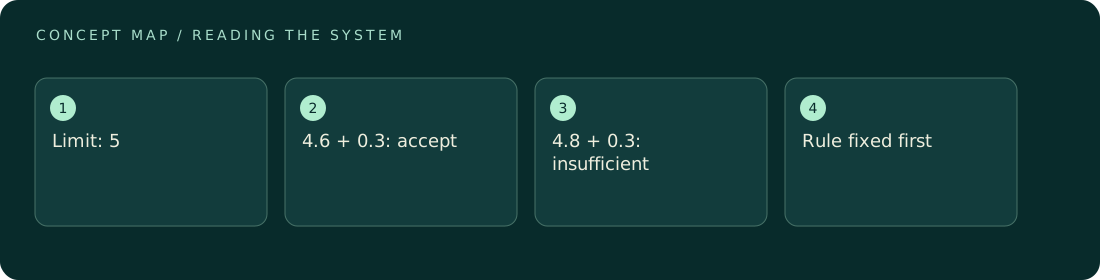
Consider a hypothetical maximum leakage requirement of 5 units. The project adopts a simple conservative rule: accept only when the measured value plus an agreed expanded uncertainty is at most 5. A reading of 4.6 with uncertainty 0.3 gives 4.9 and passes this rule. A reading of 4.8 with the same uncertainty gives 5.1 and does not qualify for acceptance. That second result is not proof that true leakage exceeds 5; it means the evidence is insufficient under the selected rule. The numbers illustrate a declared guard-band policy, not a universal standard or a calibrated probability statement.
Where interpretation fails
Changing the threshold after seeing an inconvenient result invalidates the original test of compliance unless the requirement change is openly justified and controlled. Repeating a test until it passes is equally problematic when failures remain unexplained. An uncertainty interval should not be silently reinterpreted as a guaranteed bound.
The next decision
Write and review the acceptance rule before collecting decisive evidence. When a result lies in an inconclusive region, improve the measurement or follow the predefined disposition process. Keep the requirement, criterion, raw result, uncertainty statement, and decision together so that acceptance remains traceable when the design or test method changes.
Sources & context
These sources support the concepts noted below. Our synthetic examples and research framing are educational interpretation; they are not findings from these organizations or validation of our ventures.
- NASA: Verification and Validation Plan Outline ↗
Plans identify test methods, article pedigree, and acceptance evidence.
Source check: Official outline opened; testing and article sections inspected.
Educational research context, not a validated device specification or clinical protocol. Read our editorial and correction policy.