

The essential answer
An error budget allocates allowable deviation or uncertainty in a measured or predicted quantity. A failure budget allocates the acceptable likelihood or rate of defined unsuccessful events. They address different outcomes and cannot be combined by borrowing the same arithmetic without justification. An accuracy contribution may be continuous and correlated with others; a failure event may disable the whole system or only one function. Define the top-level quantity or event first, then select a combination model whose assumptions match the architecture and evidence.
How to reason about it
For an error budget, distinguish bias, random variation, bounded tolerance, and model discrepancy. Their combination depends on whether the aim is a worst-case bound or a probabilistic uncertainty statement. For a failure budget, define exposure, mission duration, success criteria, and how component events produce system failure. A series architecture, redundancy, and a common power source create different relationships between component and system risk. Budget allocations are planning tools, not measured achievements: each contribution still requires supporting evidence and margins for unknowns. Track coupling between the two budgets where degraded accuracy itself constitutes a failure. For example, a sensor may remain electrically operational while drifting beyond its allowed error. Keeping that distinction visible prevents a team from claiming reliability merely because devices remain powered, or claiming accuracy by ignoring the probability that a channel is unavailable.
ILLUSTRATIVE · NOT A REPORTED RESULT
An example to work through
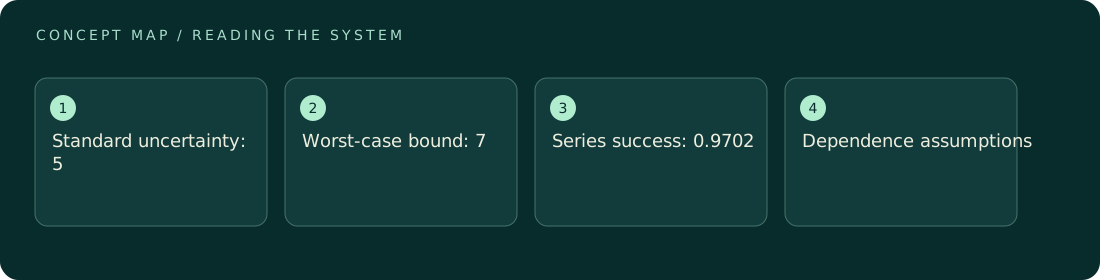
Assume two independent, zero-mean standard uncertainty contributions of 3 and 4 units. Their combined standard uncertainty is sqrt(3 squared + 4 squared) = 5 units. By contrast, if those values were hard worst-case magnitude bounds, a conservative sum would be 7 units. In a separate fictional series system, two independent component success probabilities of 0.99 and 0.98 produce system success 0.99 times 0.98 = 0.9702 for the same mission. These calculations answer different questions. Correlated uncertainty or common-cause component failures would require different models, so the arithmetic cannot be transferred merely because both documents are called budgets.
Where interpretation fails
Allocating small numbers to every subsystem does not establish the top-level claim. Dependence can defeat both an uncertainty combination and a redundancy argument. Another mistake is omitting the definition of failure, allowing a system to count as successful despite an output error that makes its intended function unusable.
The next decision
Maintain separate top-level quantities for accuracy and successful operation, with an explicit link when exceeding an error limit is a failure. Choose combination rules before assigning allocations. Revisit the budgets when shared dependencies or degraded modes are discovered, and mark unsupported allocations as targets rather than verified performance.
Sources & context
These sources support the concepts noted below. Our synthetic examples and research framing are educational interpretation; they are not findings from these organizations or validation of our ventures.
- NIST: Combining uncertainty components ↗
First-order uncertainty propagation uses sensitivity coefficients and covariance.
Source check: Official HTML opened; propagation conditions inspected.
Educational research context, not a validated device specification or clinical protocol. Read our editorial and correction policy.