
The essential answer
A component can deliver electrical power while the surrounding apparatus consumes much more. Net system output requires subtracting the energy used by necessary auxiliary equipment within a declared boundary. Pumps, heaters, lamps, agitation, controllers, and power converters can matter, especially when the studied output is small. A laboratory experiment need not be self-sustaining to be scientifically useful. Its claim should simply distinguish the measured device response from the energy performance of a complete operating system under the tested conditions.
How to reason about it
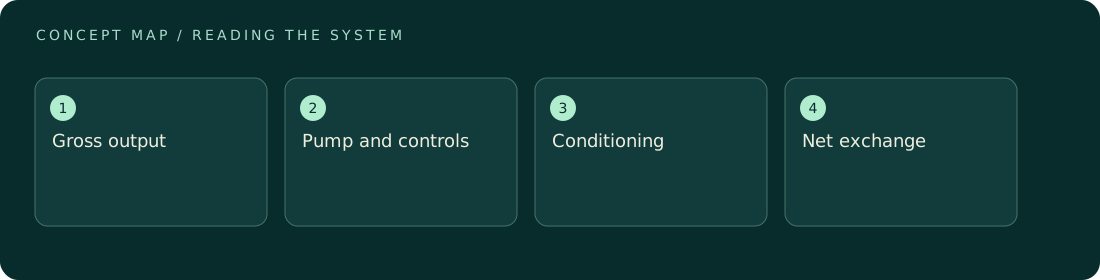
Draw the boundary before calculating the balance. List every energy flow crossing it and decide which flows are required for continuous operation rather than merely for measurement. A lamp is an input to a laboratory light-conversion setup; naturally incident sunlight may be treated as an environmental input, but it still belongs in an efficiency denominator. A data logger may be excluded from a device-only metric while an essential controller cannot be silently excluded from a system claim. Startup energy and periodic maintenance can be averaged over the relevant duty cycle, provided the accounting period is disclosed. Avoid assuming that a laboratory auxiliary scales proportionally with the active device: some loads are fixed and others depend on throughput. Report gross electrical output and auxiliary demand separately before presenting their difference, because this reveals what would need improvement.
ILLUSTRATIVE · NOT A REPORTED RESULT
An example to work through
Assume a hypothetical reactor delivers a steady 5 mW for one hour. Its gross electrical output is 5 mWh. A required pump consumes 2 mW and a required controller consumes 1 mW throughout that hour, leaving 2 mWh after those auxiliaries. If a required lamp also consumes 100 mW, the same boundary has a net electrical deficit of 98 mWh. This example ignores startup and converter losses and does not count sunlight. The boundary choice must be stated; excluding the lamp describes a component test, not the net electrically powered apparatus.
Where interpretation fails
Subtracting only the easiest auxiliary to measure can create an attractive but incomplete balance. Conversely, charging every piece of laboratory infrastructure to the device can obscure a useful component measurement. The remedy is transparent nested boundaries, with no claim that a smaller boundary establishes complete-system performance.
The next decision
Publish component output first, then show a system balance for the intended use. Separate fixed overhead from load-dependent consumption. If necessary auxiliary demand exceeds output, identify that engineering limitation directly while preserving any narrower scientific result supported by the experiment and its controls.
Sources & context
These sources support the concepts noted below. Our synthetic examples and research framing are educational interpretation; they are not findings from these organizations or validation of our ventures.
- Battery Energy Storage System Evaluation Method — DOE ↗
Background on energy-in/energy-out assessment and importance of state of charge.
Source check: Official PDF search excerpt reviewed; apparent parenthetical ratio typo in snippet not adopted.
Educational research context, not a validated device specification or clinical protocol. Read our editorial and correction policy.