

The essential answer
Two different conductive materials in a suitable electrolyte may form an electrochemical source. If a proposed energy device contains reactive electrodes, its current may partly reflect consumption of those materials or another chemical reactant. This possibility must be separated from any claimed biological, optical, or ambient mechanism. Use material-matched controls, inspect electrode changes, and track the relevant chemical boundary. A persistent current demonstrates charge transfer; identifying its energy source requires more than observing that the device is connected to a load.
How to reason about it
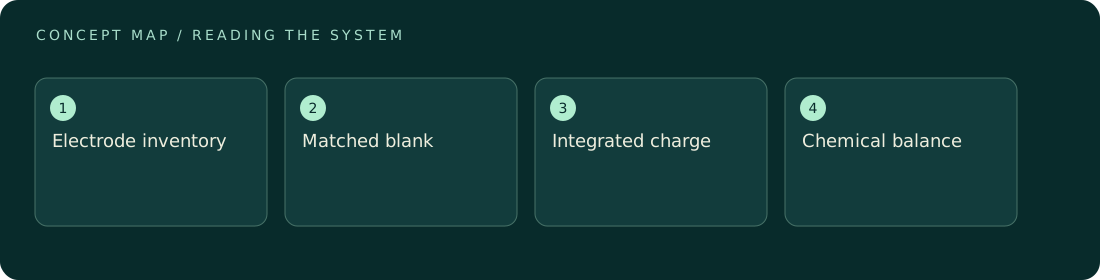
Start by inventorying every wetted conductor, including clips, wires, coatings, adhesives, and exposed substrate edges. A nominally inert electrode can contain a reactive support or a small exposed metal contact. Compare a complete assembly with controls that retain the same electrode materials, electrolyte, geometry, and electrical protocol while changing the hypothesized active component. Electrode mass measurements can constrain large consumption, but failure to resolve a small mass change does not eliminate chemistry below the detection limit. Reference-electrode measurements and chemical analysis may provide more specific evidence, depending on the system. The key reasoning step is to consider energy already stored in the initial materials. A source can run for a long time because a small reaction rate consumes a substantial reservoir, not because energy has appeared without an input. Track cumulative charge as well as current to make that possibility testable.
ILLUSTRATIVE · NOT A REPORTED RESULT
An example to work through
Assume a hypothetical cell delivers 10 microamps for 24 hours, giving Q = 0.000010 × 86,400 = 0.864 coulomb. If a candidate oxidation releases two electrons per atom, the reacted amount would be Q/(2F), approximately 4.48 micromoles using F = 96,485 C/mol. For an illustrative molar mass of 65 g/mol, that corresponds to about 0.291 mg. This is a stoichiometric possibility, not identification of a real reaction. A balance unable to resolve that mass cannot exclude the candidate merely because the electrode looks unchanged.
Where interpretation fails
A blank that changes both the electrode material and the active component does not isolate either factor. Visual inspection alone is weak evidence against corrosion. Even a chemically stable-looking setup may contain dissolved reactants or sacrificial impurities that sustain low current over a long observation window.
The next decision
Before assigning a novel energy source, test an electrode-and-electrolyte control and estimate the chemical consumption compatible with the integrated charge. Match the analytical detection limit to that estimate. If galvanic contribution remains unresolved, describe output as a mixed or unassigned electrochemical response.
Sources & context
These sources support the concepts noted below. Our synthetic examples and research framing are educational interpretation; they are not findings from these organizations or validation of our ventures.
- Circuits and Electronics — MIT OpenCourseWare ↗
Official course context for elementary circuit analysis; calculations and diagnostic protocols here are original.
Source check: Official course search excerpt reviewed; no lecture-level validation claimed.
Educational research context, not a validated device specification or clinical protocol. Read our editorial and correction policy.