

The essential answer
A capacitor can deliver current after its charging source is removed. That output is real energy transfer, but it draws on previously stored energy. In an ideal resistor-capacitor discharge, voltage falls exponentially with a time constant RC, and available energy starts at one-half C times voltage squared. A decaying trace consistent with this model is not evidence of ongoing replenishment. Conversely, a departure from one simple exponential does not prove generation, because distributed capacitance, leakage, and electrochemical relaxation can complicate the response.
How to reason about it
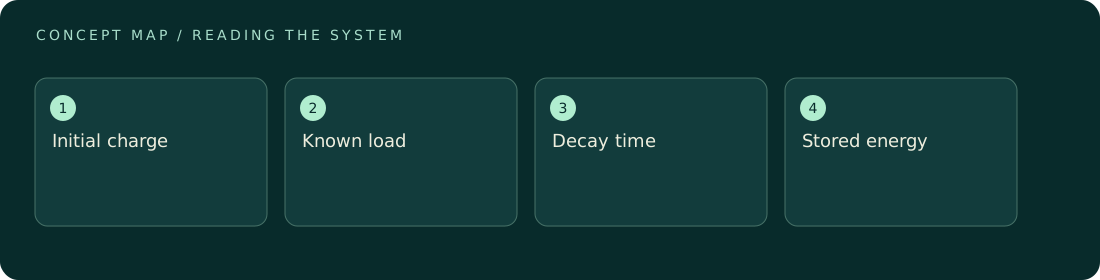
A useful diagnostic separates preparation, discharge, and recovery. Document how the sample was charged or conditioned and whether any input remains connected. Apply a known load while measuring terminal voltage and current. Compare integrated delivered energy with a plausible stored-energy estimate, acknowledging uncertainty in effective capacitance and voltage-dependent behavior. Repeat with different load resistances: an ideal RC time constant scales with resistance, offering a testable prediction. Real porous electrodes often have a distribution of timescales, so a single capacitance may describe only a limited window. Recovery after open-circuit rest can reflect redistribution of internal charge, not fresh energy acquisition. To argue for sustained harvesting, identify an external input and show repeatable net energy delivery beyond the initial stored-state contribution under a controlled cycle. The observation window should span enough of the decay to distinguish a brief transient from a plateau.
ILLUSTRATIVE · NOT A REPORTED RESULT
An example to work through
Assume an ideal 1 millifarad capacitor starts at 1 V and discharges through 10 kilohms with no other input. The time constant is 10 seconds and initial energy is 0.5 × 0.001 × 1² = 0.0005 J. After one time constant the voltage is about 0.368 V, leaving about 13.5% of the initial energy because energy depends on voltage squared. Roughly 0.432 mJ has reached the resistor by then. This example assumes no leakage, dielectric absorption, voltage dependence, or instrument loading beyond the stated resistor.
Where interpretation fails
A slow decay can look flat over a short display window. Repeated voltage recovery after rest is also not sufficient evidence of regeneration. Internal redistribution can restore terminal voltage while the total stored energy continues to decrease. Measure full-cycle energy rather than only the recovered peak.
The next decision
Use load-dependent decay and energy integration as first checks. If the output fits a storage explanation, label it discharge. If it does not, investigate alternative storage and chemical mechanisms before assigning replenishment. A sustained-source claim needs an identified input and a repeatable energy balance.
Sources & context
These sources support the concepts noted below. Our synthetic examples and research framing are educational interpretation; they are not findings from these organizations or validation of our ventures.
- Circuits and Electronics — MIT OpenCourseWare ↗
Official course context for elementary circuit analysis; calculations and diagnostic protocols here are original.
Source check: Official course search excerpt reviewed; no lecture-level validation claimed.
Educational research context, not a validated device specification or clinical protocol. Read our editorial and correction policy.