

The essential answer
A conservation residual is the mismatch between accumulation and the net sources and boundary transfers of a conserved quantity. It checks whether the reported fields and fluxes satisfy a balance at a defined scale. Compute it independently from the solver's internal convergence indicator where possible. A small algebraic residual for an iterative algorithm and a small physical balance error answer different questions. State the control volume, signs, time interval, units, and normalization so another reader can reproduce and interpret the reported discrepancy.
How to reason about it
For a general balance, write accumulation equals inflow minus outflow plus internal generation. Integrate over the full domain and, when useful, over smaller regions that might hide cancellation. In a transient problem, storage is often the missing term that makes an otherwise correct simulation appear nonconservative. In a steady problem, verify that the stored quantity has actually stopped changing before dropping accumulation. Use boundary fluxes evaluated consistently with the discretization and inspect interface transfers between coupled submodels. Normalize by a physically meaningful throughput or source scale; dividing by a nearly zero net flux can exaggerate a harmless absolute error. Conversely, normalizing by an enormous unrelated quantity can conceal a consequential leak. The residual is best treated as a diagnostic with a decision-specific limit, accompanied by the absolute balance in physical units and a record of the terms that contribute to it.
ILLUSTRATIVE · NOT A REPORTED RESULT
An example to work through
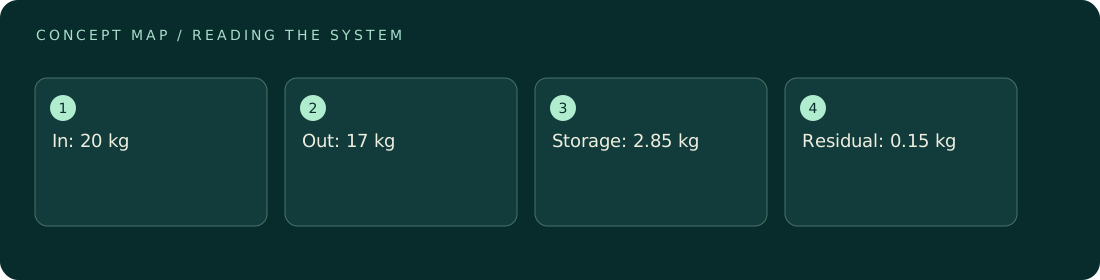
Consider an invented tank calculation over ten seconds. Measured or simulated inflow is 2.00 kg/s and outflow is 1.70 kg/s, with no source. Expected accumulation is (2.00 - 1.70) times 10 = 3.00 kg. If reported tank mass rises by 2.85 kg, the interval balance residual is 0.15 kg, equivalent to 0.015 kg/s. Normalized by inflow, the discrepancy is 0.75 percent. Calling the 0.30 kg/s inflow-outflow difference an error would be wrong because most of it is real storage. The remaining discrepancy should be compared with integration accuracy and measurement uncertainty before diagnosing its cause.
Where interpretation fails
Opposing local errors can cancel in a whole-domain balance, so a good global total does not guarantee locally credible transport. Also avoid interpreting a residual percentage without its denominator. A one-percent number based on total inflow is not comparable to one based on the much smaller net inflow.
The next decision
Require a documented balance whenever the conclusion depends on transport, conversion, or accumulation. If it fails the chosen tolerance, first check signs, units, storage, and interface accounting. Then investigate solver convergence or discretization. Do not calibrate a material parameter to compensate for unexplained loss of a conserved quantity.
Sources & context
These sources support the concepts noted below. Our synthetic examples and research framing are educational interpretation; they are not findings from these organizations or validation of our ventures.
- NASA: Verification Assessment ↗
Consistency, temporal convergence, and independent numerical methods are verification checks.
Source check: Official tutorial opened; verification process inspected.
Educational research context, not a validated device specification or clinical protocol. Read our editorial and correction policy.