

The essential answer
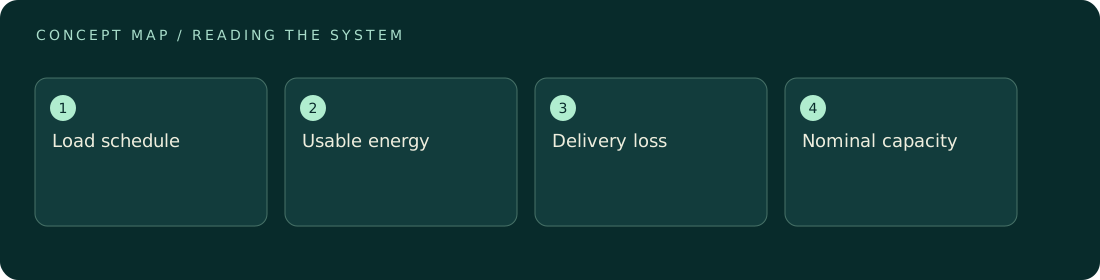
Storage sizing begins with the energy the load needs over time and the largest power it requires. Integrate the load schedule, account for delivery losses, then divide by the usable fraction of nominal capacity. Add an explicit reserve if the application requires one. Check power capability separately: enough watt-hours do not guarantee the device can meet a startup surge. This arithmetic is a planning model whose assumptions should be updated with actual temperature, aging, cutoff, and duty-cycle information.
How to reason about it
Write a simple timeline containing each operating mode and its duration. Include sleep current, communications bursts, and required control electronics if they share the storage supply. Convert all intervals to compatible units before summing energy. A delivery efficiency adjusts the energy required at the storage terminals; an allowed discharge fraction adjusts nominal capacity. These are different factors and should not be merged into an unexplained margin. If a manufacturer already specifies usable energy at the system boundary, applying the same reductions again double counts them. Reserve can mean extra runtime, capacity uncertainty, or an emergency state limit, so define it. Finally, check recharge opportunity: a large store cannot sustain repeated operation if the average incoming energy is inadequate. Sizing therefore connects three conditions—energy quantity, instantaneous delivery capability, and replenishment over the complete duty cycle.
ILLUSTRATIVE · NOT A REPORTED RESULT
An example to work through
Assume an illustrative instrument needs 2 W for 3 hours and 0.1 W for the remaining 21 hours of a day. Load energy is 6 + 2.1 = 8.1 Wh. With a constant assumed 90% delivery efficiency, storage must supply 9 Wh. If only 80% of nominal capacity may be used, nominal capacity must be at least 11.25 Wh before reserve. Adding 20% capacity reserve gives 13.5 Wh. This example ignores aging and temperature effects; its separate power requirement is at least the 2 W operating load, plus any unmodeled surge.
Where interpretation fails
Sizing only from the active mode can miss a large cumulative sleep demand. Another error is mixing ampere-hours across different voltages without converting to energy. A nominal voltage is an approximation, so a detailed design should use the actual discharge curve and converter behavior where available.
The next decision
Use a transparent load table and keep efficiency, usable fraction, and reserve separate. Check peak power and recharge energy after calculating capacity. Treat the resulting size as conditional on the stated assumptions, and revise it when measured duty cycles or environmental performance become available.
Sources & context
These sources support the concepts noted below. Our synthetic examples and research framing are educational interpretation; they are not findings from these organizations or validation of our ventures.
- Battery Energy Storage System Evaluation Method — DOE ↗
Background on energy-in/energy-out assessment and importance of state of charge.
Source check: Official PDF search excerpt reviewed; apparent parenthetical ratio typo in snippet not adopted.
Educational research context, not a validated device specification or clinical protocol. Read our editorial and correction policy.