
The essential answer
A light-dark comparison tests whether an electrical response changes with illumination under the chosen conditions. It does not, by itself, identify the microscopic pathway or prove that all delivered energy comes directly from current illumination. Heating, electrode photochemistry, stored metabolites, capacitive transients, and instrument behavior may also change. Stronger tests repeat illumination cycles, monitor temperature, preserve electrical loading, and include suitable nonliving or component controls. The conclusion should name the observed response and the alternatives that remain plausible.
How to reason about it
Treat illumination as an experimental intervention with timing and side effects. Record intensity at the sample, spectrum when relevant, exposure duration, and the delay between switching and analysis. Keep the load and measurement range unchanged across conditions. Alternate or randomize sequences when feasible so a monotonic drift does not masquerade as a light effect. A thermal control can help determine whether a response follows temperature rather than photons, but its temperature history must be comparable. Dark intervals may still contain energy released from earlier illumination or chemical stores. Likewise, an immediate spike can reflect charging rather than sustained conversion. Inspect both transient and settled windows instead of choosing whichever produces the largest difference. Independent samples and repeated cycles address different uncertainties: one tests reproducibility across devices, while the other tests reversibility within a device.
ILLUSTRATIVE · NOT A REPORTED RESULT
An example to work through
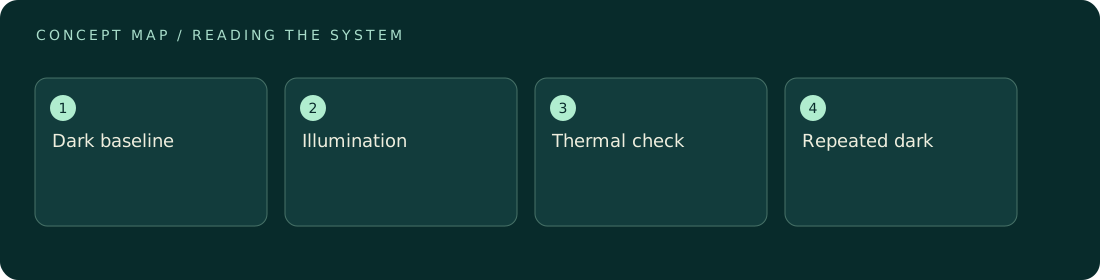
Imagine a hypothetical sample at fixed load gives 10 microamps in darkness, 14 microamps in light, and 12 microamps in the next dark interval. Assume the two dark readings bracket a slow linear drift. Their average is 11 microamps, giving a drift-adjusted light-associated difference of 3 microamps rather than the 4 microamps obtained from the first dark point alone. This arithmetic is illustrative; linear drift is an assumption that needs testing. It does not determine whether the difference is biological, thermal, photochemical, or capacitive. Additional controls would address those alternatives.
Where interpretation fails
Subtracting a single early dark value from every later light value can convert drift into a persistent illumination effect. Treating all dark output as background is also unsafe when stored energy is part of the mechanism. Preserve the full sequence and explain the subtraction model.
The next decision
Use repeated paired conditions to establish a reproducible light-associated change, then add controls targeted to competing mechanisms. Report gross and baseline-adjusted signals together. Reserve stronger attribution for a consistent pattern across electrical, thermal, biological, and temporal evidence rather than one contrast alone.
Sources & context
These sources support the concepts noted below. Our synthetic examples and research framing are educational interpretation; they are not findings from these organizations or validation of our ventures.
- The Development of Biophotovoltaic Systems for Power Generation — Cambridge repository ↗
Background that photosynthetic microorganisms associated with electrodes can produce illumination-stimulated extracellular current.
Source check: Repository abstract/search excerpt reviewed; review paper, not independent validation of a device.
Educational research context, not a validated device specification or clinical protocol. Read our editorial and correction policy.