

The essential answer
A negative result is informative when the experiment could have detected an effect or behavior large enough to matter and its controls show that the test operated as intended. A result that does not support a claim is not automatically proof of no effect. Report the estimated effect, uncertainty, tested conditions, and sensitivity of the design. Preserve negative outcomes because they can constrain mechanisms and prevent repeated dead ends, but distinguish a well-supported absence within a defined range from insufficient or compromised evidence.
How to reason about it
Begin with the claim the experiment was designed to test. If the relevant question is whether improvement exceeds a practical threshold, an interval relative to that threshold is more informative than a simple significant or nonsignificant label. Check positive controls, instrument range, and manipulation fidelity before interpreting a null response. A failed intervention or saturated measurement can produce an uninformative flat result. Also consider whether the tested conditions represent the domain of the broader claim. A carefully executed negative result at one temperature does not exclude a response at all temperatures. Preserve the protocol, exclusions, raw data, and analysis so others can judge what was ruled out. When reporting, separate a contradiction of a precise prediction from failure to observe an imprecise one. The scientific contribution often lies in narrowing the plausible region, even when the hoped-for improvement was not demonstrated.
ILLUSTRATIVE · NOT A REPORTED RESULT
An example to work through
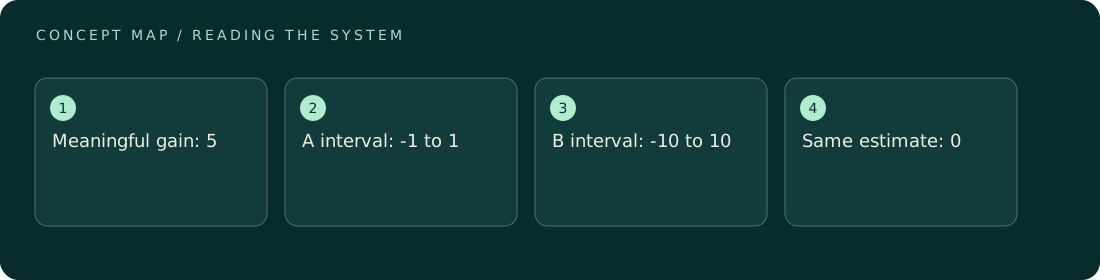
Assume a fictional process change is worthwhile only if it improves output by at least 5 units. Experiment A estimates an improvement of 0 with an illustrative uncertainty interval from -1 to 1. Experiment B also estimates 0, but its interval spans -10 to 10. Under the stated interval interpretation, A provides much stronger evidence against an improvement as large as 5 in the tested conditions. B remains compatible with both substantial benefit and substantial harm. The identical point estimates therefore support different conclusions. These intervals are assumed for explanation and are not presented as results of a real statistical study.
Where interpretation fails
Equating no statistically significant difference with equivalence is a common error. A noisy or small experiment can miss a large effect. Another trap is suppressing negative runs while highlighting favorable exploratory subsets, which distorts the evidence available to anyone deciding whether to repeat or build on the work.
The next decision
Report a negative result with the effect size, interval meaning, controls, and practical threshold. If the experiment excludes effects that matter, state that bounded conclusion. If it remains too imprecise or failed a control, call it inconclusive and identify the design change needed for a more informative follow-up.
Sources & context
These sources support the concepts noted below. Our synthetic examples and research framing are educational interpretation; they are not findings from these organizations or validation of our ventures.
- Center for Open Science: Registered Reports ↗
Registered Reports separate initial evaluation from eventual outcomes.
Source check: Official program page opened; overview inspected.
Educational research context, not a validated device specification or clinical protocol. Read our editorial and correction policy.