

The essential answer
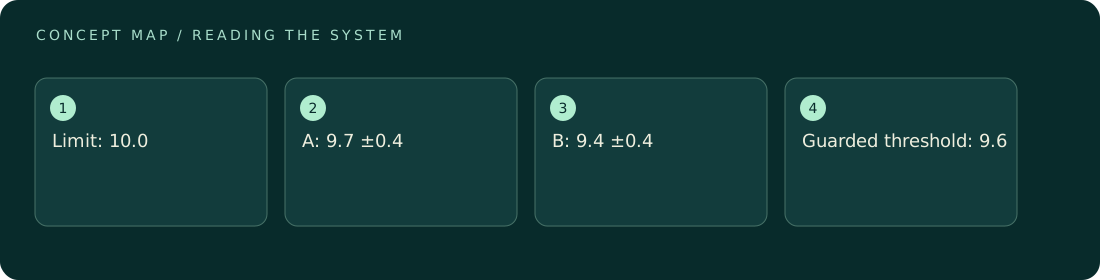
For an illustrative upper limit of 10.0 units, a measured value 9.7 with expanded uncertainty 0.4 has an interval reaching 10.1. It passes a simple value-only rule but does not pass the stated conservative rule requiring the entire interval below the limit. These are different decision policies, not conflicting arithmetic. The measurement and its uncertainty should remain visible so reviewers can see which policy was applied and what risk assumptions it represents.
How to reason about it
A specification defines acceptable true performance, while a decision rule translates uncertain evidence into an action. One possible rule accepts an upper-limit result only when y+U≤L, where U is the declared expanded uncertainty. This introduces a guard band: the measured value must lie at least U below the limit. Such a rule is a teaching choice here, not a universal standard or an automatic 95 percent guarantee. Coverage depends on the uncertainty evaluation, distribution, and factor. A value near the boundary may be inconclusive under a three-way policy rather than proven nonconforming. NIST supplies uncertainty concepts; the acceptance threshold and policy are explicitly illustrative. Repeated tests should not be selectively retained until one happens to pass.
ILLUSTRATIVE · NOT A REPORTED RESULT
An example to work through
Use illustrative upper specification L=10.0 units. Case A gives y=9.7 with U=0.4, yielding interval [9.3,10.1]. The guarded acceptance check is 9.7+0.4=10.1≤10.0, which is false. The value-only check 9.7≤10.0 is true. Case B gives y=9.4 with the same U, so its upper bound is 9.8 and it passes the guarded rule. Case C gives y=10.6 with U=0.4, so its lower bound is 10.2, above the limit, and the interval lies wholly outside specification. Under an illustrative three-way classification, A is inconclusive, B is accepted, and C is rejected. With U=0.4 fixed, the guarded measured-value threshold is L−U=9.6. If Case A uncertainty could validly be reduced to 0.2 while retaining y=9.7, its upper bound would be 9.9 and the decision would change. Merely reporting fewer uncertainty components would not justify that reduction.
Where interpretation fails
Failure to satisfy a conservative acceptance rule is not identical to proof that the true value violates specification. Treating every borderline result as definitively bad erases the role of uncertainty. Conversely, suppressing uncertainty to obtain a pass changes presentation rather than evidence and undermines the stated decision policy.
The next decision
Choose the decision rule and treatment of inconclusive results before examining outcomes. For this illustrative case, record A as inconclusive under the guarded policy, along with its measured value and interval. Further action should address uncertainty or performance through justified evidence rather than repeated selective testing.
Sources & context
These sources support the concepts noted below. Our synthetic examples and research framing are educational interpretation; they are not findings from these organizations or validation of our ventures.
- NIST TN 1297: Combined Standard Uncertainty ↗
Covariance belongs in uncertainty propagation; recognized systematic effects need correction.
Source check: Relevant sections 5.1–5.2 read
Educational research context, not a validated device specification or clinical protocol. Read our editorial and correction policy.