

The essential answer
Versioned data lets a team identify exactly which observations and corrections produced a result. Preserve prior states, record the reason for each change, and connect derived outputs to their input versions. A filename such as final is not a stable identifier, and a timestamp alone may not reveal what changed. Treat raw acquisition records as evidence to preserve while applying corrections through traceable transformations. The purpose is not to prevent legitimate improvement; it is to make improvement visible and allow earlier results to be reconstructed.
How to reason about it
Choose a versioning approach suited to file size, collaboration, and access constraints. Small text tables may fit ordinary source control, while large binary datasets often need a separate object store and a manifest of stable identifiers or checksums. Record schema changes as carefully as value changes because a renamed column or altered unit can silently break an analysis. Each released dataset should include its provenance, relevant calibration version, exclusion rules, and relationship to earlier releases. Derived files should point to the transformation code and configuration that created them. A checksum confirms byte identity, not scientific correctness, so pair integrity checks with semantic validation. When a correction affects a published or shared conclusion, identify the impacted outputs rather than merely replacing a file in place. A clear version graph helps collaborators understand whether two apparently conflicting results used different evidence.
ILLUSTRATIVE · NOT A REPORTED RESULT
An example to work through
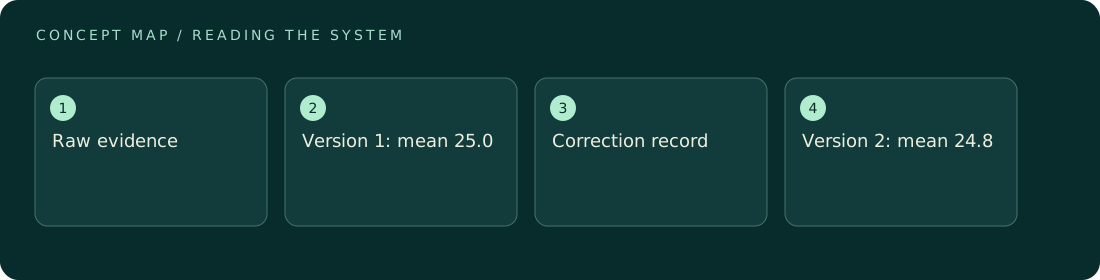
Imagine dataset version 1 contains ten temperature readings whose sum is 250 degrees Celsius, giving a mean of 25.0. A documented transcription correction changes one reading from 30 to 28. Version 2 therefore sums to 248 and has mean 24.8. The original acquisition record remains preserved, and the correction log names the evidence supporting the change. A plot made from version 1 remains traceable even though version 2 is preferred for new work. These invented values show why silently overwriting the table can make a previously reported mean impossible to explain and obscure whether an analysis itself changed.
Where interpretation fails
Automatic cloud synchronization is not necessarily a sufficient scientific version record. It may preserve bytes without explaining units, exclusions, or the reason for a correction. Conversely, keeping many copies with informal names can create ambiguity when collaborators cannot identify which version belongs to a particular result.
The next decision
Require every consequential output to reference a stable input version and transformation configuration. Preserve corrections as new traceable states, and assess which conclusions they affect. If the exact input cannot be recovered, label the result's provenance incomplete and reconstruct it before presenting the output as independently reproducible evidence.
Sources & context
These sources support the concepts noted below. Our synthetic examples and research framing are educational interpretation; they are not findings from these organizations or validation of our ventures.
- OSF: Files and Folders ↗
File version histories and informative organization support research reuse.
Source check: Official support HTML opened; organization and version sections inspected.
Educational research context, not a validated device specification or clinical protocol. Read our editorial and correction policy.