
The essential answer
A reproducibility package contains the materials and instructions needed to regenerate a stated result from the same underlying data. It should identify inputs, transformations, software environment, execution steps, and expected outputs, including limitations on access or exact numerical agreement. A folder of code is not enough if hidden manual steps or unavailable dependencies remain essential. Design the package around one clear entry point and test it from a clean setting. The goal is a result another person can reconstruct without relying on the original analyst's memory.
How to reason about it
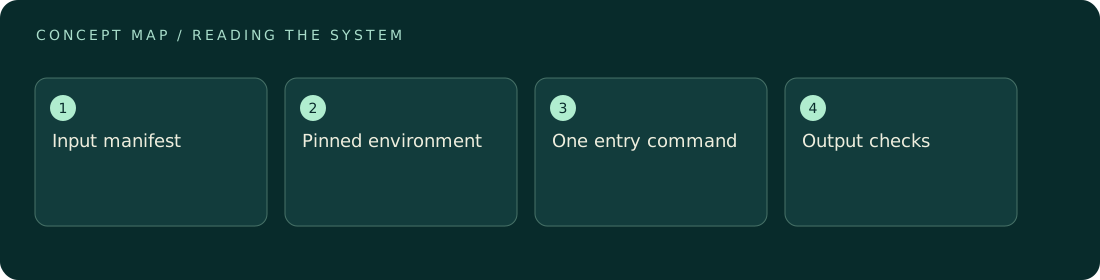
Begin with a manifest connecting each reported figure or number to its source data and producing command. Preserve raw inputs separately from derived files and describe their schema, units, and missing-value conventions. Record software versions and configuration, including random seeds where relevant, while acknowledging that hardware or parallel execution can still affect exact numerical reproducibility. Provide a small smoke test when the full workflow is expensive, but distinguish that test from complete regeneration. Document manual judgments as explicit inputs or procedures rather than leaving them implicit. Include expected output checks with meaningful tolerances and explain differences that are acceptable. Access restrictions should be stated honestly; synthetic demonstration data can verify mechanics without reproducing the original scientific result. Finally, ask someone unfamiliar with the project to run the instructions and record the obstacles they encounter before considering the package complete.
ILLUSTRATIVE · NOT A REPORTED RESULT
An example to work through
Suppose an illustrative report contains one calibration slope and two plots. The package manifest maps all three outputs to raw.csv, a configuration file, and one analysis command. A clean run produces slope 2.003 units per volt; the stated expected value is 2.003 with tolerance 0.001. A second person obtains 2.0034, which passes that numerical check. They also confirm that both plots were regenerated from the listed data rather than copied from stored images. This constructed example tests computational reconstruction only. It does not independently confirm the calibration experiment or show that the data represent the intended physical process.
Where interpretation fails
Saving a notebook with already-rendered outputs can hide cells executed out of order or results created by an unavailable local file. Another trap is describing the package as reproducible after only the original author runs it in a familiar environment with undeclared dependencies already installed.
The next decision
Release a package when a clean execution reproduces the stated outputs within documented tolerances and every necessary input is available or its restriction is explicit. If a step remains manual, make it reviewable and repeatable. State whether the package supports full reconstruction, a limited demonstration, or only inspection of methods.
Sources & context
These sources support the concepts noted below. Our synthetic examples and research framing are educational interpretation; they are not findings from these organizations or validation of our ventures.
- OSF: Sharing Research Outputs ↗
Workflow, environment, metadata, and persistent identifiers make outputs usable.
Source check: Official support HTML opened.
Educational research context, not a validated device specification or clinical protocol. Read our editorial and correction policy.