
The essential answer
Environmental qualification evaluates whether a design can meet its requirements under defined environmental conditions and exposures. It links the intended operating and survival envelope to a planned set of tests or analyses, often including justified margins. The claim applies to the qualified configuration and tested or analytically supported conditions. It is not a universal guarantee of durability. Distinguish operation during exposure from survival followed by restored operation, and record the article's pedigree so evidence from a representative unit is transferred to other units only with justification.
How to reason about it
Develop the environmental profile from the actual life cycle: transport, storage, installation, operation, and maintenance may impose different stresses. Identify which combinations and sequences matter, because a temperature exposure followed by vibration may reveal behavior that isolated tests miss. Select test levels, duration, monitoring, and functional checks based on requirements and an applicable project standard rather than inventing generic severity. Define permissible degradation and failure criteria in advance. Record pretest configuration and performance so changes can be detected afterwards. An accelerated exposure needs a defensible relationship to the relevant mechanism; simply increasing stress can introduce a different failure mode. When the design changes, assess whether earlier qualification evidence still applies. The final report should state what was tested, observed, and excluded, including any interrupted exposures, repairs, or deviations that affect the scope of the claim.
ILLUSTRATIVE · NOT A REPORTED RESULT
An example to work through
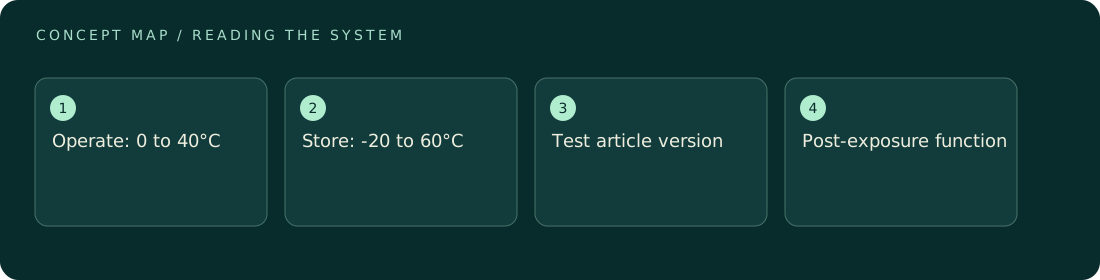
Suppose a fictional instrument must operate from 0 to 40 degrees Celsius and survive storage from -20 to 60. A test that stores the unpowered unit at -20 and then verifies it at 20 supports one survival condition. It does not establish operation at -20, which was not required, nor operation at 0, which still needs appropriate evidence. If its enclosure seal is changed after the test, the team must assess whether the prior exposure remains representative. This diagnostic example contains no proposed qualification temperatures or durations for a real product; it illustrates how requirement wording controls the claim.
Where interpretation fails
Passing one severe exposure does not automatically cover every milder-looking environment, especially when combinations or different mechanisms matter. Another trap is testing a specially prepared unit and transferring the result to a changed production design without documenting equivalence. Qualification margins must have a rationale, not merely look demanding.
The next decision
Define the environmental claim and article configuration before selecting tests. Accept qualification evidence only within its justified envelope and assess design changes against that evidence. If a required condition was not addressed, identify the gap explicitly and complete the relevant test or analysis before claiming the full operating range.
Sources & context
These sources support the concepts noted below. Our synthetic examples and research framing are educational interpretation; they are not findings from these organizations or validation of our ventures.
- NASA: Product Verification ↗
Qualification addresses design performance in anticipated environmental conditions.
Source check: Official handbook HTML opened; qualification section inspected.
Educational research context, not a validated device specification or clinical protocol. Read our editorial and correction policy.