
The essential answer
An experiment log records what was actually done and observed, including departures from the plan. It connects a run's result to specimen identity, apparatus configuration, calibration, environment, timing, operator actions, and raw data. Record events while they occur rather than reconstructing them from memory after an attractive result appears. A useful log separates observations from interpretations and preserves unsuccessful or invalid runs. It should answer why two nominally identical trials may differ without requiring the original operator to explain unwritten details.
How to reason about it
Give each run a unique identifier that appears in both the log and acquisition files. Capture the planned settings and the measured conditions, because commanded values may differ from what the apparatus delivered. Record configuration versions for hardware, software, firmware, and analysis where they affect interpretation. Mark interventions with synchronized timestamps when possible, including resets, adjustments, sensor changes, and interruptions. Describe anomalies concretely: a channel saturated for three seconds is more useful than data looked bad. State exclusions and their reasons without deleting the underlying record. Keep hypotheses about causes separate from confirmed facts so later reviewers can reconsider them. The logging burden should be proportionate and supported by automatic capture of routine metadata, leaving the operator free to note events that software cannot infer. A short consistent log is usually more useful than a rich form filled in only for successful runs.
ILLUSTRATIVE · NOT A REPORTED RESULT
An example to work through
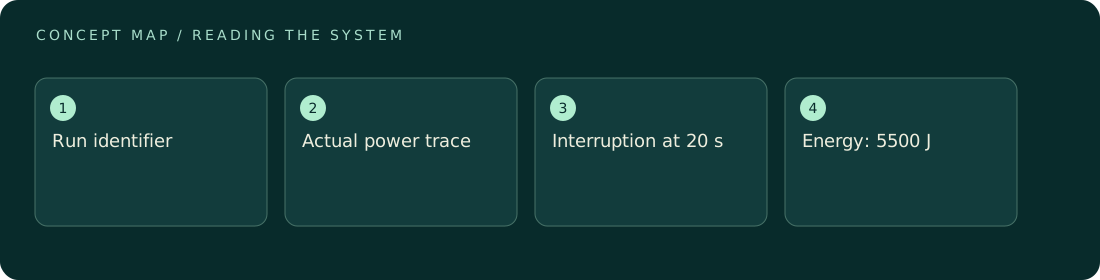
In a fictional heating trial, the target power is 100 W for 60 seconds. At second 20, an operator notices a loose connector and restarts the supply; power is absent for five seconds. Ideal delivered energy is therefore 100 times 55 = 5500 J rather than the nominal 6000 J, assuming power is otherwise constant. A lower final temperature may reflect that interruption instead of a material change. A timestamped log and actual power trace make the distinction reviewable. Recording only the target setting and final temperature would leave the missing 500 J invisible to a later analyst.
Where interpretation fails
Logs written only after analysis tend to emphasize events that support the preferred explanation. Another problem is overwriting an anomalous run with a repeat under the same identifier. That removes information about reproducibility and makes the relationship between acquisition files, interventions, and reported summaries difficult to recover.
The next decision
Create the logging template and run identifiers before the campaign. Automatically capture stable metadata and require contemporaneous notes for interventions and anomalies. If essential context is missing, qualify the interpretation and repeat the experiment when necessary; do not fill gaps with an undocumented assumption that the planned conditions were achieved.
Sources & context
These sources support the concepts noted below. Our synthetic examples and research framing are educational interpretation; they are not findings from these organizations or validation of our ventures.
- OSF: Files and Folders ↗
File version histories and informative organization support research reuse.
Source check: Official support HTML opened; organization and version sections inspected.
Educational research context, not a validated device specification or clinical protocol. Read our editorial and correction policy.