

The essential answer
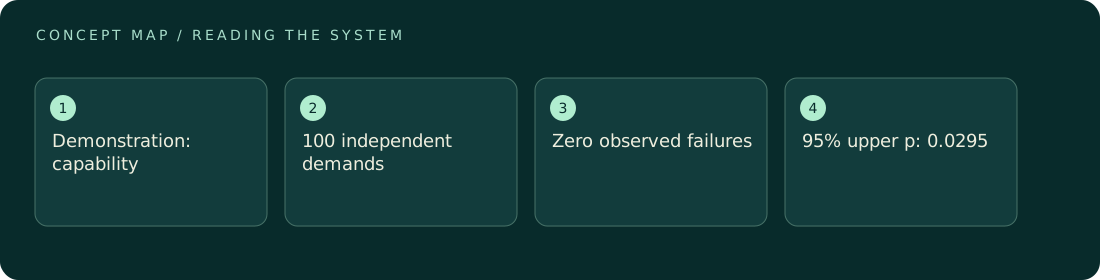
A successful demonstration shows that a system performed a function under the demonstrated conditions. Reliability concerns how consistently it performs that function over a defined duration, usage, or number of demands. Establishing reliability requires exposure and an appropriate statistical or engineering model, including a clear failure definition. Zero observed failures is useful evidence but not proof of zero failure probability. Record the number of independent opportunities, operating conditions, censoring, repairs, and configuration changes so the claim can be assessed rather than inferred from a memorable successful run.
How to reason about it
Define success at the system level and specify whether the question concerns a single demand, a continuous mission, or repeated operation. Select a model consistent with the mechanisms and data. A constant-rate lifetime model, for example, has assumptions that may be inappropriate for wear-out or early manufacturing defects. Repeated cycles on one item may share conditions and damage history, so they are not automatically equivalent to independent trials on many items. Distinguish development testing, where failures lead to design changes, from evidence about a fixed configuration. Track exposure accumulated before and after each change separately. Reliability evidence can combine tests, field observations, and analysis, but the combination must make its assumptions visible. A demonstration can be an important development milestone while still leaving substantial uncertainty about rare failures or long-duration performance.
ILLUSTRATIVE · NOT A REPORTED RESULT
An example to work through
For a simple illustrative demand model, assume independent identical trials with unknown failure probability p. After n = 100 trials with zero failures, a one-sided 95-percent upper bound solves (1 - p) to the power 100 = 0.05. Thus p = 1 - 0.05 to the power 0.01, approximately 0.0295. Even 100 successes do not establish a failure probability below one percent at that confidence under this model. The common approximation 3/n gives 0.03 here. Dependence between trials, changing conditions, or a changing design would weaken the applicability of this calculation.
Where interpretation fails
Counting every successful cycle as independent evidence can greatly overstate confidence when all cycles share one specimen or an easy environment. Another error is resetting the failure count after a repair while retaining all earlier successful exposure, without explaining why the repaired configuration belongs to the same reliability population.
The next decision
Match the reliability claim to the available exposure and assumptions. Use demonstrations to establish capability, then plan evidence for the desired consistency and duration. If the required rare-event claim exceeds what the test can support, report the bound or limitation honestly and combine additional testing with mechanism-based analysis where justified.
Sources & context
These sources support the concepts noted below. Our synthetic examples and research framing are educational interpretation; they are not findings from these organizations or validation of our ventures.
- NIST: Exponential life distribution tests ↗
Constant-rate lifetime tests require an explicit exponential model.
Source check: Official handbook HTML opened; assumptions inspected.
Educational research context, not a validated device specification or clinical protocol. Read our editorial and correction policy.