

The essential answer
Thermal expansion describes dimensional change with temperature under specified mechanical conditions. For a small interval with nearly constant linear expansion coefficient, free length change is approximately alpha times initial length times temperature change. A constrained part may instead develop stress, and a bonded pair can bend because its constituents expand differently. The coefficient can vary with temperature and direction, so a single room-temperature number is not a universal description. State whether the calculation concerns free expansion, mismatch, or constrained response.
How to reason about it
Choose the reference length and temperature before using an expansion coefficient. Over a wide range, integrate the temperature-dependent coefficient or use reliable tabulated length changes rather than extending a constant approximation. Anisotropic materials can require direction-specific values. In an assembly, include the surrounding fixtures: apparent sample movement may partly come from the measurement frame. Differential expansion is often more important than the absolute change of either component. A stress estimate adds mechanical assumptions about stiffness, bonding, geometry, and whether relaxation or slip is allowed. Temperature gradients further complicate the picture because different regions expand by different amounts. A simple uniform-temperature calculation is valuable as a scale estimate, but it should be labeled accordingly. Check both heating and cooling when irreversible structural changes or hysteresis could affect the dimensional response.
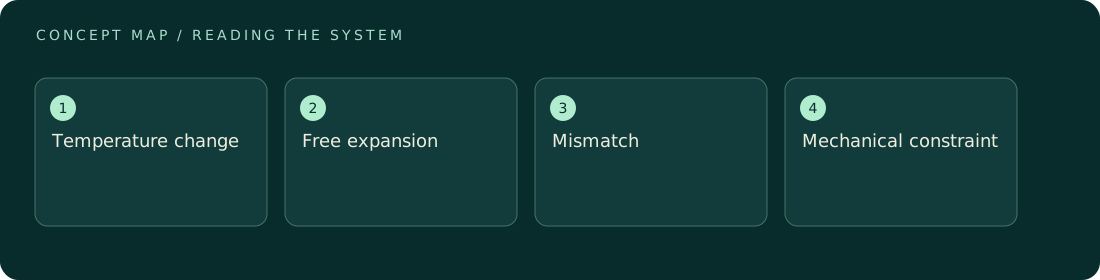
ILLUSTRATIVE · NOT A REPORTED RESULT
An example to work through
Assume a hypothetical free bar is 0.20 m long and has a constant linear expansion coefficient of 10 micrometers per meter per kelvin over a 30 K temperature rise. Its length increase is 10 × 10⁻⁶ × 0.20 × 30 = 60 micrometers. A second bar with half that coefficient increases by 30 micrometers under the same assumptions. Their free mismatch is therefore 30 micrometers. Bonding the bars would change the mechanical response; this arithmetic alone does not determine the resulting curvature, stress, or risk of interface failure.
Where interpretation fails
A free-expansion formula does not predict stress unless constraints are modeled. Using a coefficient outside its temperature range can also produce incorrect dimensions. When measurements approach very small displacements, fixture expansion and thermal gradients may be comparable to the sample signal and need independent consideration.
The next decision
Use constant-coefficient estimates for a clearly limited temperature interval. For assemblies, compare constituent expansion and then model the actual constraints. Report reference temperature, material direction, and thermal uniformity, and verify the dimensional response under the intended heating and cooling cycle when precision matters.
Sources & context
These sources support the concepts noted below. Our synthetic examples and research framing are educational interpretation; they are not findings from these organizations or validation of our ventures.
- Properties of Selected Materials at Cryogenic Temperatures — NIST ↗
Background distinguishing thermal expansion and its coefficient as temperature-dependent material properties.
Source check: Official publication abstract/search excerpt reviewed.
Educational research context, not a validated device specification or clinical protocol. Read our editorial and correction policy.