

The essential answer
Diffusion spreads concentration differences through random microscopic motion. A characteristic time often scales as length squared divided by diffusivity, so doubling a relevant distance can make equilibration roughly four times slower in the same model. The numerical prefactor depends on geometry and boundary conditions. This scaling is a useful first estimate, not a universal completion time. Reactions, flow, electric fields, binding, and heterogeneous pathways can change transport and must be considered when interpreting a real material or device.
How to reason about it
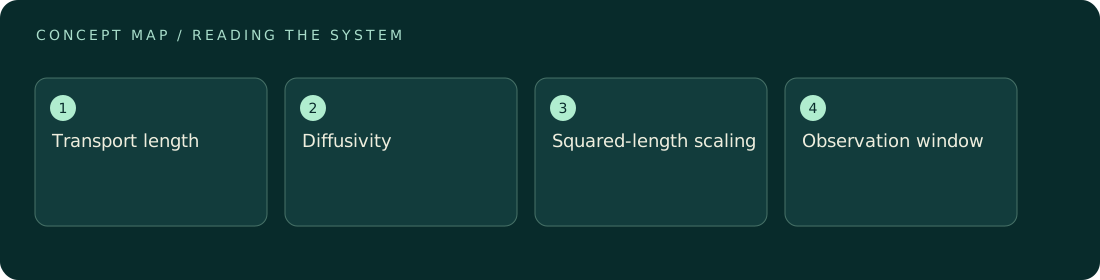
Identify the length that the species actually traverses. It may be a film thickness, particle radius, pore distance, or distance between a reservoir and a reaction site. The overall device dimension is not always the relevant scale. State whether diffusivity is constant and whether the medium is homogeneous and stationary. In a porous network, tortuosity and inaccessible regions can make an effective description different from the molecular diffusivity in free liquid. Boundary conditions determine whether the surface concentration is held fixed, flux is imposed, or material is sealed. “Equilibrated” also needs a tolerance because diffusion approaches a uniform state progressively rather than reaching it at a single universal instant. Compare the estimated time with the measurement window: a short experiment may probe only a near-surface region, while a long one may become sensitive to reaction or depletion elsewhere.
ILLUSTRATIVE · NOT A REPORTED RESULT
An example to work through
Assume one-dimensional diffusion with a constant hypothetical diffusivity of 10⁻¹⁰ m²/s and use t ~ L²/D only as an order-of-magnitude estimate. For L = 10 micrometers, L²/D = 1 second. For L = 100 micrometers, it is 100 seconds. Increasing length by a factor of ten therefore increases this characteristic time by a factor of one hundred. The calculation does not specify a concentration tolerance or exact boundary conditions, so neither value is an exact equilibration deadline. Flow or reaction could invalidate the simple estimate entirely.
Where interpretation fails
A fitted slow timescale is not automatically diffusion. Relaxation, reaction kinetics, or instrument drift can yield similar traces. Using the external sample size instead of the actual transport path can also produce orders-of-magnitude errors because the length enters squared. Test geometry dependence where practical.
The next decision
Use L²/D to plan a measurement window and identify plausible transport limits. Then compare experiments with different thicknesses or controlled boundary conditions. Assign diffusion as a mechanism only when its spatial and temporal predictions agree with evidence beyond a single fitted decay time.
Sources & context
These sources support the concepts noted below. Our synthetic examples and research framing are educational interpretation; they are not findings from these organizations or validation of our ventures.
- Electrochemical Impedance Imaging via the Distribution of Diffusion Times ↗
Primary mathematical work on distributions of diffusion times; no claimed performance reproduced.
Source check: Primary preprint abstract reviewed in search output.
Educational research context, not a validated device specification or clinical protocol. Read our editorial and correction policy.