

The essential answer
An interface can control transport or mechanical response even when it occupies little volume. Heat, charge, mass, and stress must cross boundaries between constituents, and those boundaries can add resistance, alter bonding, or concentrate deformation. Bulk properties alone therefore may not predict an assembled device. Identify whether the relevant pathways are in series, parallel, or a more complex network. Then measure or bound the interface contribution under the actual pressure, environment, and preparation conditions rather than assuming perfect continuity.
How to reason about it
A series pathway provides an intuitive starting point: every transferred quantity must cross each layer and interface, so the largest resistance can dominate the total. Parallel pathways behave differently because transport can favor an easier route. Geometry determines which picture is appropriate. For a thermal stack, distinguish material thermal resistance from an interface resistance and use compatible area definitions. For mechanical bonding, distinguish stiffness from strength and toughness; a stiff interface is not automatically resistant to crack growth. Processing can change interfacial chemistry without visibly changing bulk dimensions. Aging, moisture, or cycling may also alter an interface earlier than the surrounding material. A useful experiment varies one interface condition while keeping bulk components matched, then checks whether the predicted assembly response changes. This is more informative than attributing every deviation from a bulk model to an unspecified “surface effect.”
ILLUSTRATIVE · NOT A REPORTED RESULT
An example to work through
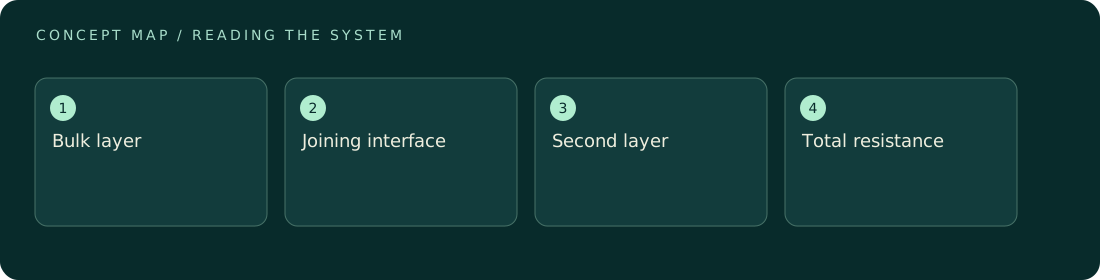
Assume a one-dimensional hypothetical thermal stack carries 2 W through two layers and their joining interface. Each bulk layer has a thermal resistance of 1 K/W, while the interface contributes 3 K/W. Total resistance is 5 K/W, producing a 10 K temperature difference across the stack. The interface accounts for 6 K of that drop. If interface resistance were reduced to 1 K/W with the layers unchanged, total temperature difference would fall to 6 K. These are constructed steady-state values assuming no lateral heat loss and a common heat flow through every element.
Where interpretation fails
A very thin interface is not necessarily a negligible interface. Conversely, assigning all unexplained resistance to it ignores errors in bulk geometry, lateral losses, or sensor placement. State the transport network and test competing explanations before extracting an interface property from a total assembly measurement.
The next decision
Measure the whole assembly and use controlled changes in thickness or interface preparation to separate contributions. Preserve the relevant contact pressure and environment. If the interface dominates, improving a bulk constituent may offer little benefit; prioritize the boundary condition supported by the measured resistance budget.
Sources & context
These sources support the concepts noted below. Our synthetic examples and research framing are educational interpretation; they are not findings from these organizations or validation of our ventures.
- Influence of surface roughness and waviness upon thermal contact resistance — NASA ↗
Primary report context for interface geometry affecting transport; electrical example is an independent circuit calculation.
Source check: NASA technical-report bibliographic/search excerpt reviewed.
Educational research context, not a validated device specification or clinical protocol. Read our editorial and correction policy.