

The essential answer
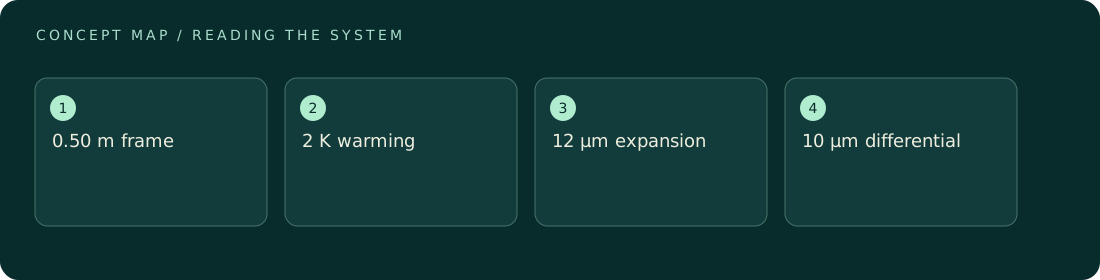
An illustrative half-metre frame with expansion coefficient 12 micrometres per metre per kelvin changes length by 12 micrometres when its temperature rises by 2 kelvin. A displacement signal of only 3 micrometres could therefore be smaller than a plausible thermal contribution. This does not prove that temperature caused the signal: the observed direction depends on mounting and reference geometry. It establishes why differential expansion and thermal monitoring belong in the measurement model.
How to reason about it
For a small temperature interval and approximately constant coefficient α, free expansion is ΔL=αLΔT. This relates a material length to its own temperature, not automatically to room-air temperature. Mounting constraints can turn expansion into stress or bending, and gradients can invalidate a single-temperature approximation. A differential instrument compares two paths, so the relevant drift is often the difference between their expansions. Equal nominal lengths do not cancel if coefficients or temperatures differ. The NIST source provides background on thermal expansion quantities; the coefficient here is an assumed example value, not a material certification. Tracking a temperature-correlated signal is a diagnostic, while correcting it requires a calibrated relation and an uncertainty estimate for the correction.
ILLUSTRATIVE · NOT A REPORTED RESULT
An example to work through
Choose illustrative L=0.50 m, α=12×10⁻⁶ K⁻¹, and ΔT=2.0 K. Then ΔL=12×10⁻⁶×0.50×2=12×10⁻⁶ m=12 µm. Suppose a reference arm of the same length has assumed coefficient 2×10⁻⁶ K⁻¹ and experiences the same temperature change. Its expansion is 2 µm, leaving differential drift 12−2=10 µm. If the differential signal of interest is 3 µm, this modeled drift is 10/3=3.33 times larger. With temperature-change standard uncertainty 0.10 K and all other inputs provisionally exact, the temperature contribution to differential uncertainty is |12−2|×10⁻⁶×0.50×0.10=0.50 µm. This is only one uncertainty component. For an ideally free frame, keeping its absolute expansion below 1 µm would require |ΔT|<1×10⁻⁶/(12×10⁻⁶×0.50)=0.1667 K. That bound does not address gradients, constraints, or uncertainty in the coefficient.
Where interpretation fails
Subtracting a thermal estimate as though it were exact can make a result look cleaner while hiding correction uncertainty. Another trap is assuming that a room sensor equals frame temperature during a transient. Thermal lag can cause a delayed geometric response even when the ambient reading has already stabilized.
The next decision
Determine which physical lengths the instrument compares and whether they expand freely. For the illustrative geometry, differential drift is the useful calculation. Treat the result as a reason to model and characterize temperature coupling, not as proof that an observed displacement is entirely thermal or entirely nonthermal.
Sources & context
These sources support the concepts noted below. Our synthetic examples and research framing are educational interpretation; they are not findings from these organizations or validation of our ventures.
- NIST: Thermal expansion of technical solids at low temperatures ↗
Thermal expansion coefficients describe temperature-dependent length changes.
Source check: Search abstract and indexed introduction reviewed; no material coefficient taken from this source
Educational research context, not a validated device specification or clinical protocol. Read our editorial and correction policy.