

The essential answer
A prototype demonstrates or explores selected behavior in a particular configuration. A specification defines the required behavior, interfaces, constraints, and conditions for an intended product or system. The prototype can inform the specification, but it does not replace it. Its success may depend on hand adjustment, selected components, a skilled operator, or a narrow environment. Translate what was learned into explicit requirements and evidence gaps before treating the prototype as a reproducible design suitable for other builders, users, or operating conditions.
How to reason about it
Identify the question each prototype was built to answer. A proof of principle might establish that a mechanism can produce an effect, while an engineering prototype might test integration or manufacturing choices. Neither necessarily establishes production variation, service life, environmental tolerance, or complete interface compatibility. Record the as-built configuration and undocumented interventions because they may explain why the demonstration worked. Then compare the demonstrated envelope with the required one. Turn successful but implicit operating conditions into explicit constraints, and plan tests for the missing regions. A specification should also distinguish essential behavior from incidental details of the first build, allowing better implementations where appropriate. When handing off to another team, require enough information to reproduce the intended function without relying on the original designer's presence. The gap between those two situations is often the most useful measure of remaining development work.
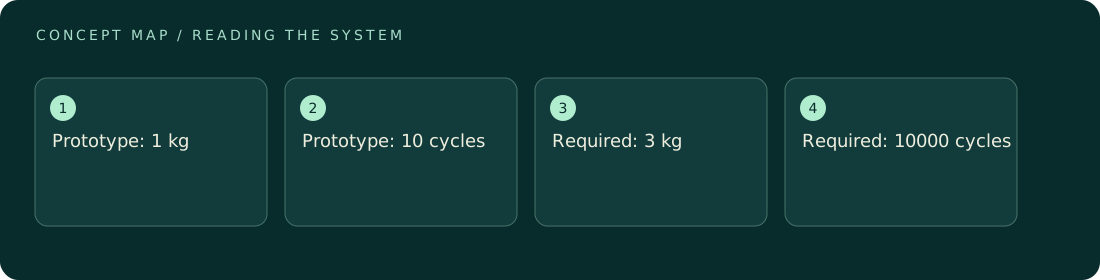
ILLUSTRATIVE · NOT A REPORTED RESULT
An example to work through
Imagine a fictional actuator prototype moves a 1 kg load through 20 mm at room temperature for ten cycles. The intended product must move 3 kg through the same distance for 10,000 cycles over a broader temperature range. The prototype demonstrates the mechanism under one limited condition; it does not demonstrate the load, life, or environmental requirements. If the original builder manually adjusts alignment every two cycles, that intervention is also part of the demonstrated configuration. A specification must either allow that maintenance explicitly or require a design and test that eliminates it. The counts describe an illustrative gap analysis, not real hardware performance.
Where interpretation fails
A polished enclosure and successful demonstration can create an illusion of maturity. Conversely, copying every prototype detail into a specification can preserve accidental choices that have no connection to the user need. Both mistakes obscure which behaviors are required and which have actually been supported by evidence.
The next decision
Use a prototype result to close only the questions its configuration and test addressed. Before production or external handoff, define interfaces, operating limits, acceptance criteria, and unresolved evidence needs. Treat manual adjustments and selected parts as explicit conditions until repeatable manufacturing and operation have demonstrated that they are unnecessary.
Sources & context
These sources support the concepts noted below. Our synthetic examples and research framing are educational interpretation; they are not findings from these organizations or validation of our ventures.
- NASA: Verification and Validation Plan Outline ↗
Plans identify test methods, article pedigree, and acceptance evidence.
Source check: Official outline opened; testing and article sections inspected.
Educational research context, not a validated device specification or clinical protocol. Read our editorial and correction policy.