

The essential answer
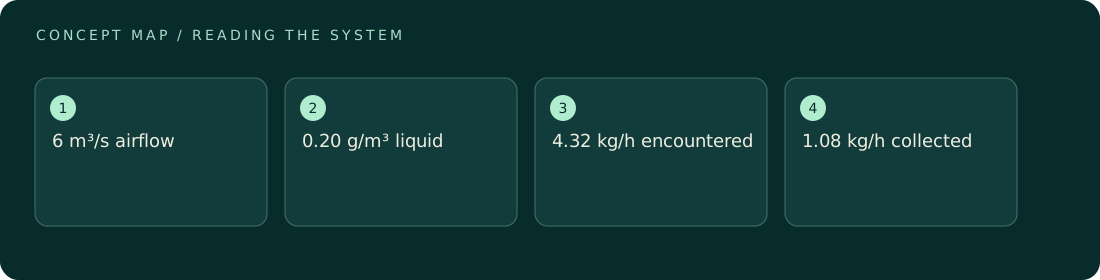
An illustrative two-square-metre collector in a three-metre-per-second flow encounters 4.32 kilograms of fog liquid water per hour when liquid water content is 0.20 grams per cubic metre. At an assumed net capture fraction of 25 percent, collected water is 1.08 kilograms per hour. The result depends on liquid droplets already present in passing air. It is not a calculation of all water vapour in the air, and it does not establish potable water quality.
How to reason about it
The intercepted liquid mass flow is liquid water content multiplied by normal air speed and effective frontal area. A collection fraction accounts for droplets that follow airflow around the collector, pass through it, splash away, or fail to drain into storage. This simplified balance assumes uniform flow and liquid content across the area and interval. A quoted geometric mesh area may differ from the effective capture area. Wind direction changes the projected area and normal velocity. The source supplies atmospheric context; the numerical mass balance is independently constructed. Fog liquid content and humidity are different quantities: saturated air can contain little suspended liquid, while a dense fog contains droplets that scatter light. A vapour-condensation device needs a separate heat and mass transfer model.
ILLUSTRATIVE · NOT A REPORTED RESULT
An example to work through
Use illustrative liquid water content w=0.20 g/m³, frontal area A=2.0 m², and normal speed v=3.0 m/s. Air volume crossing per second is Av=6.0 m³/s. Intercepted liquid flow is wAv=1.20 g/s. Over 3600 seconds, the encountered mass is 4320 g=4.32 kg. With assumed net efficiency η=0.25, collected mass is 1.08 kg per hour. If those conditions persist for six hours, collection is 6.48 kg, approximately 6.48 litres when using 1 kg/L for water density. If speed halves while everything else is artificially held constant, the model predicts 0.54 kg per hour. If liquid content also halves, it predicts 0.27 kg per hour. Those proportional changes are model sensitivities, not weather forecasts. A 10 litre target would require about 10/1.08=9.26 hours at the initial steady conditions. Real changing conditions should be integrated over time instead of extending the best hour across a day.
Where interpretation fails
Relative humidity is not interchangeable with fog liquid water content. Using the entire vapour inventory as collectible droplet mass can produce a large overestimate. Another error is applying a published efficiency to a different droplet-size distribution or wind speed without checking whether the same collection physics applies.
The next decision
Start with the mass crossing the effective aperture and then apply a justified net capture fraction. The example supports a conditional yield calculation, not a site recommendation. A real assessment would need representative liquid content, wind direction, drainage losses, collection records, and an independent water-quality evaluation.
Sources & context
These sources support the concepts noted below. Our synthetic examples and research framing are educational interpretation; they are not findings from these organizations or validation of our ventures.
- National Weather Service: Fog Safety Overview ↗
Fog is an atmospheric visibility phenomenon; the collection calculation is an original mass balance.
Source check: Official overview browsed
Educational research context, not a validated device specification or clinical protocol. Read our editorial and correction policy.