

The essential answer
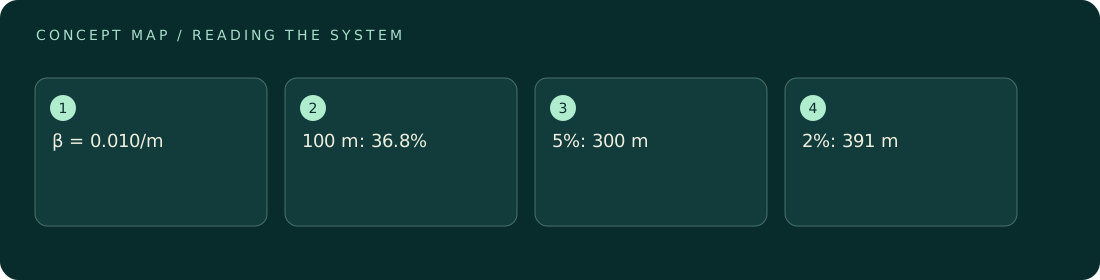
With illustrative uniform extinction coefficient 0.010 per metre, direct transmission over 100 metres is exp(−1), about 36.8 percent. A simplified contrast threshold of 5 percent corresponds to a range of about 300 metres; a 2 percent threshold gives about 391 metres. Visibility therefore depends on its observational convention as well as extinction. The same optical attenuation cannot uniquely determine fog water content without information about droplet sizes and wavelength.
How to reason about it
For a homogeneous path, Beer-type attenuation gives direct-beam transmission T=exp(−βL). A related idealized contrast relation gives range V=−ln(Cthreshold)/β for a dark target against an appropriate uniform background. This contrast model is not a universal description of every scene. Illumination, target contrast, path inhomogeneity, instrument wavelength, and multiple scattering can matter. In particular, direct transmission and perceived visibility are different observables. A change in droplet sizes can alter extinction per unit water mass, so a conversion from visibility to collected water is underdetermined without a microphysical model. The cited research summary supports wavelength dependence; the numerical values and threshold comparison are original illustrative calculations rather than reproductions of a fog experiment.
ILLUSTRATIVE · NOT A REPORTED RESULT
An example to work through
Assume illustrative β=0.010 m⁻¹. For L=100 m, optical depth is βL=1 and direct transmission is exp(−1)=0.367879. For L=200 m, it is exp(−2)=0.135335. Thus doubling distance does not halve transmission; it squares the transmission for this uniform case. Using a contrast threshold of 0.05 gives V=−ln(0.05)/0.010=299.573 m. Using 0.02 gives V=391.202 m. The latter is about 30.6 percent longer solely because the convention changed. Conversely, an idealized 300 m range defined at 5 percent contrast corresponds to β=−ln(0.05)/300=0.00998577 m⁻¹. If β varies along the path, replace βL with the integral of β over distance. Two successive 50 m segments with coefficients 0.005 and 0.015 m⁻¹ have total optical depth 0.25+0.75=1, giving the same direct transmission as the original uniform 100 m path.
Where interpretation fails
Calling the 5 percent threshold range the only correct visibility hides a convention. Likewise, treating extinction as pure absorption misses the role of scattering in fog. A small direct-beam signal does not mean that all missing light energy has been deposited locally as heat.
The next decision
State wavelength, attenuation observable, and threshold alongside any visibility estimate. For this example, report the two conditional ranges rather than merging them. Avoid inferring liquid-water yield from visibility alone; that next calculation requires droplet information or an independently established relation appropriate to the atmospheric conditions.
Sources & context
These sources support the concepts noted below. Our synthetic examples and research framing are educational interpretation; they are not findings from these organizations or validation of our ventures.
- Duthon et al.: Influence of Wavelength on the Extinction Coefficient ↗
Extinction and visibility depend on wavelength and fog conditions.
Source check: Indexed research-paper summary reviewed; full page returned rate limit
Educational research context, not a validated device specification or clinical protocol. Read our editorial and correction policy.