

The essential answer
Fatigue concerns changes and possible failure under repeated loading. A material can survive one load application yet degrade after many cycles, so static strength alone does not establish endurance. The relevant variables include amplitude, mean load, rate, environment, geometry, and prior history. Define failure before testing: fracture, stiffness loss, leakage, or another functional threshold may be appropriate. Distinguish irreversible damage from reversible heating or viscoelastic conditioning, since these can produce similar short-term changes in measured response.
How to reason about it
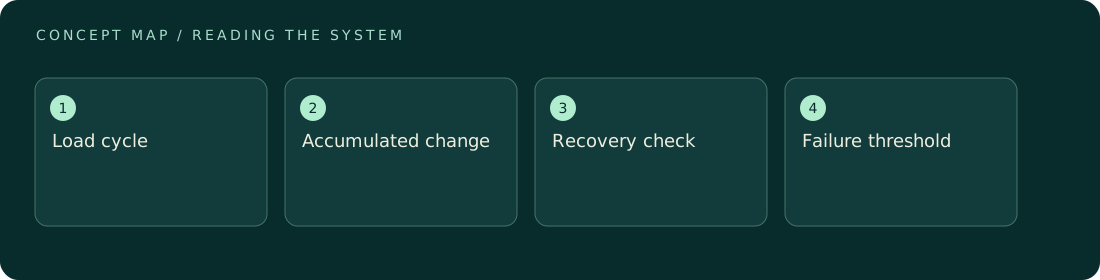
Record the complete loading cycle rather than only its maximum. Tensile and compressive portions, dwell times, and the minimum load can alter the response. Use multiple specimens when estimating variability; one long-lived sample does not define a reliable lifetime distribution. Interrupted tests and recovery intervals can help determine whether a change persists after temperature and relaxation effects subside. Monitor a relevant property over cycles, but avoid assuming that its rate of change remains constant until failure. Crack initiation, propagation, and final instability can occupy different parts of life. A test accelerated by increasing frequency may introduce heating or a different mechanism, so acceleration requires validation. When comparing materials, match geometry and stress concentration or explicitly model their influence. A useful fatigue result is always conditional on the tested loading and environmental envelope.
ILLUSTRATIVE · NOT A REPORTED RESULT
An example to work through
Assume a hypothetical component starts with stiffness 100 N/mm and reaches 90 N/mm after 10,000 identical cycles. If the predeclared functional threshold is a 15% stiffness loss, this observation has not yet reached that threshold. A linear extrapolation would predict 85 N/mm at 15,000 cycles, but that is only an unvalidated model: damage could accelerate, slow, or recover after rest. Suppose stiffness returns to 96 N/mm after cooling; part of the initial change was reversible. These invented values illustrate why cycle counts, recovery protocol, and failure definition must travel together.
Where interpretation fails
Treating “survived N cycles” as “will last indefinitely” extends beyond the observation. Likewise, a stiffness drop during rapid cycling may partly be thermal. Report runout specimens as censored observations and separate the measured endpoint from any model-based lifetime extrapolation or safety claim.
The next decision
Select a functional failure criterion and reproduce the relevant load spectrum. Monitor temperature and recovery where needed to separate reversible effects. Use a population of tests for reliability questions, and state the limits of extrapolation beyond tested amplitude, frequency, environment, or cycle count.
Sources & context
These sources support the concepts noted below. Our synthetic examples and research framing are educational interpretation; they are not findings from these organizations or validation of our ventures.
- Viscoelastic Assessment Method of Polymeric Foams Under Cyclic Fatigue — NIST ↗
Primary study context linking repeated compression and time-dependent mechanical response.
Source check: Official publication abstract/search excerpt reviewed.
Educational research context, not a validated device specification or clinical protocol. Read our editorial and correction policy.