

The essential answer
A relaxation spectrum represents a response as contributions with different characteristic times. It is useful when one exponential cannot describe the observed decay, but it is not automatically a map of distinct microscopic mechanisms. Finite observation windows, noise, and model choices can make multiple spectra fit similar data. Report which timescales the experiment can resolve and how sensitive the inferred spectrum is to assumptions. A compact model may predict behavior well even when its individual components lack a unique physical interpretation.
How to reason about it
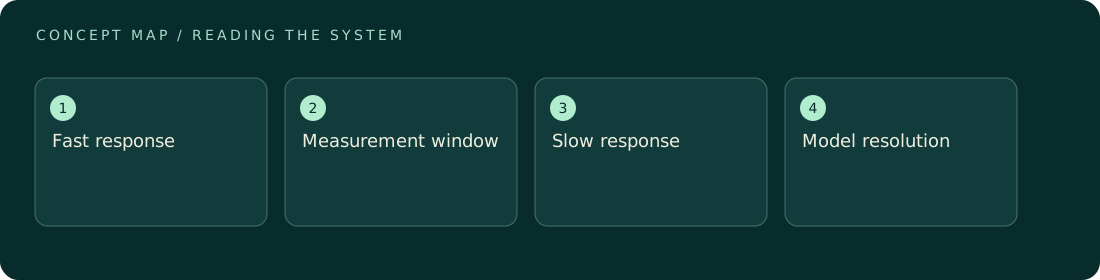
For a simple linear representation, a response can be written as a sum of weighted exponential decays plus a long-time offset. Fast components may finish before the first reliable sample, while slow components may look like a constant drift during the experiment. Recovering many weights and times from a short trace is therefore an inverse problem with limited information. Regularization or choosing a small number of components can stabilize fitting, but each introduces assumptions about smoothness or complexity. Compare predictions at held-out times or under a different excitation rather than relying only on a small residual. Temperature changes may shift relaxation times, but a shifted curve does not by itself identify the underlying process. Explain the accessible time window and distinguish a phenomenological description from a mechanistic assignment. This keeps a visually detailed spectrum from implying more resolution than the data support.
ILLUSTRATIVE · NOT A REPORTED RESULT
An example to work through
Assume a constructed response is 0.6 exp(−t/1 s) + 0.4 exp(−t/100 s), normalized to one at t = 0. At 10 seconds the fast contribution is about 0.000027 and the slow contribution about 0.362, giving approximately 0.362 overall. A measurement beginning only at 10 seconds would barely observe the fast process. A measurement ending at 10 seconds would barely constrain the slow decay. These exact illustrative components are chosen by construction; a real noisy trace need not permit their unique recovery even if a two-exponential fit looks convincing.
Where interpretation fails
Adding more exponentials almost always improves a fit but may create poorly constrained components. A smooth recovered spectrum can also reflect the smoothing rule rather than material detail. Do not label peaks as specific molecular or structural mechanisms without independent evidence that distinguishes those assignments.
The next decision
Choose sampling and duration to cover the timescales relevant to the application. Compare simple and distributed descriptions, inspect uncertainty, and test predictions outside the fitting window. Report a broad relaxation range when the data support that conclusion more strongly than a list of precise individual times.
Sources & context
These sources support the concepts noted below. Our synthetic examples and research framing are educational interpretation; they are not findings from these organizations or validation of our ventures.
- Viscoelastic Characterization of Sealant Materials — NIST ↗
Background on testing and modeling time-dependent mechanical properties.
Source check: Official publication abstract/search excerpt reviewed.
Educational research context, not a validated device specification or clinical protocol. Read our editorial and correction policy.