

The essential answer
Dimensionless groups combine variables so their units cancel while retaining a physically meaningful ratio. They help compare experiments with different sizes or operating conditions and reveal which effects can plausibly be neglected. A match in one group supports similarity only for the mechanisms represented by that group. Geometry, boundary conditions, other relevant groups, and material behavior may still differ. Use nondimensionalization to clarify a model and choose experiments, then test whether the collapsed data actually share the predicted relationship across the intended operating domain.
How to reason about it
Choose characteristic scales for length, time, velocity, and any transported quantity. Substitute scaled variables into the governing balance and inspect the coefficients that remain. A large or small coefficient suggests a possible limiting approximation, but does not automatically justify deleting a term everywhere. A thin boundary region can retain an effect that is weak in the bulk. Scaling is also useful numerically: variables with comparable magnitudes can make tolerances easier to interpret, although scaling alone cannot repair an unstable algorithm. Record the reference scales with every nondimensional result so the dimensional prediction can be reconstructed. For comparative experiments, list all groups thought to control the response and state which are matched, intentionally varied, or left unmatched. This turns a vague claim of similarity into a testable statement about a particular regime and observable.
ILLUSTRATIVE · NOT A REPORTED RESULT
An example to work through
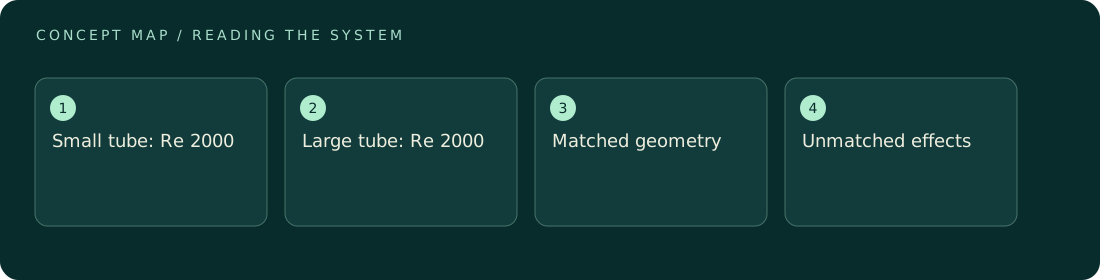
For a constructed water-flow comparison, assume density 1000 kg per cubic metre and dynamic viscosity 0.001 Pa s. A 0.01 m diameter tube at mean velocity 0.2 m/s has Reynolds number rho U D/mu = 2000. A geometrically similar 0.02 m tube at 0.1 m/s also gives 2000. Under the same fluid model and compatible inlet conditions, matching this ratio supports a comparison of inertial and viscous effects. It does not establish equal pressure drop in pascals. The larger tube has a different dimensional scale, and roughness relative to diameter must also be considered before transferring a resistance result.
Where interpretation fails
A tidy collapse plot can conceal selective normalization or an omitted control variable. Do not conclude that two systems are equivalent because one number agrees. Matching Reynolds number alone does not guarantee similarity when compressibility, gravity, surface tension, thermal transport, or a changing geometry affects the observable being compared.
The next decision
Use nondimensional groups when transferring evidence between scales or deciding which terms deserve attention. Approve a similarity claim only after recording the governing assumptions and unmatched groups. If data refuse to collapse, investigate missing mechanisms and boundary differences before fitting a more elaborate universal curve to the same points.
Sources & context
These sources support the concepts noted below. Our synthetic examples and research framing are educational interpretation; they are not findings from these organizations or validation of our ventures.
- NASA Glenn: Reynolds Number ↗
Reynolds number compares inertial and viscous effects.
Source check: Official educational HTML opened.
Educational research context, not a validated device specification or clinical protocol. Read our editorial and correction policy.