

The essential answer
Extrapolation uses a model beyond the conditions adequately represented by its supporting evidence. It is not only about exceeding the minimum or maximum of one input: a new combination, material, geometry, or operating mechanism can also leave the supported domain. A smooth curve and a narrow fitted interval do not guarantee credible behavior there. State the distance and type of transfer, identify assumptions that may fail, and seek a targeted confirmation measurement before relying on an extrapolated result for a consequential decision.
How to reason about it
Map the observed domain in terms of the variables and regimes that plausibly control the response. For several inputs, a point may lie within every separate range while being far from any observed combination. Mechanistic reasoning can strengthen an extrapolation when it constrains limiting behavior, but only if the relevant mechanism remains active. A new phase, saturation, instability, or failure mode can invalidate a previously useful approximation. Compare several plausible model forms to reveal how strongly the requested prediction depends on assumptions that the data do not distinguish. Treat their spread as a diagnostic, not automatically as a calibrated uncertainty interval. Design confirmation points near the intended use condition and, when possible, along the path from the established domain. Updating the model after those measurements should preserve the earlier prediction so its performance can be assessed honestly.
ILLUSTRATIVE · NOT A REPORTED RESULT
An example to work through
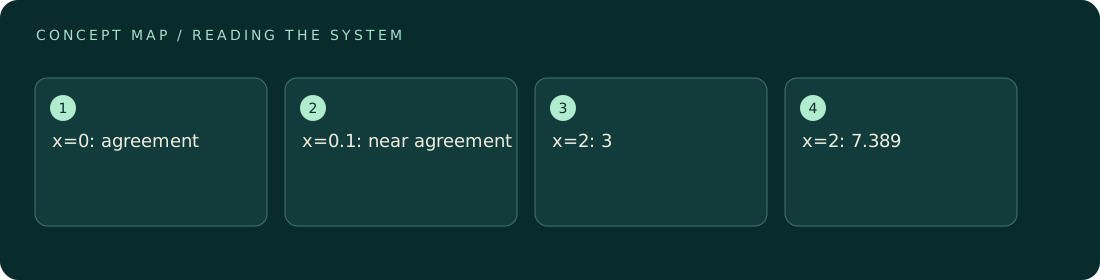
Suppose invented measurements near x = 0 support a response near y = 1 with local slope 1. Two candidate forms, y = 1 + x and y = exp(x), share the same value and slope at zero. At x = 0.1 they predict 1.1 and approximately 1.1052, a difference of about 0.0052. At x = 2 they predict 3 and approximately 7.389, differing by 4.389. Close local agreement therefore cannot choose the distant behavior. A measurement near the intended x = 2 operating condition would be far more informative than another extremely precise observation at zero.
Where interpretation fails
A statistical prediction interval often accounts for estimated parameters and noise within the fitted model, not for all alternative mechanisms beyond the data. Do not treat a narrow interval as a license to extend the operating range. Clipping an implausible prediction after the fact can conceal rather than resolve the unsupported model behavior.
The next decision
Label extrapolated outputs explicitly and restrict their use according to the consequence of being wrong. If alternative plausible models diverge enough to change the decision, obtain confirmation data or redesign around a conservative supported range. Record which regime boundaries and untested assumptions make the transfer uncertain before presenting a precise numerical forecast.
Sources & context
These sources support the concepts noted below. Our synthetic examples and research framing are educational interpretation; they are not findings from these organizations or validation of our ventures.
- NIST: Model use beyond the data domain ↗
Predictions away from observations need confirmatory data.
Source check: Official handbook HTML opened.
Educational research context, not a validated device specification or clinical protocol. Read our editorial and correction policy.