

The essential answer
Copying produces a representation or counterpart of something. Replication in origins research usually concerns a process through which entities contribute to producing further entities of their kind. The precise mechanism and external support must be stated. Research on RNA enzymes demonstrates a particular self-sustained replication system under supplied conditions. That result does not mean every form of copying is equivalent, or that a replication mechanism alone constitutes an entire living cell. The claim should remain attached to its defined system.
How to reason about it
A photocopier makes copies, but the copied page does not thereby acquire the copier's machinery. This familiar analogy helps separate information being reproduced from the process responsible for reproduction. In a molecular study, the interesting questions include what the template contributes, which components are supplied, and whether products can participate in subsequent production. The word self can hide those dependencies if it is read as meaning no environment or support. A careful description names the boundary of the system and the inputs assumed within it. Fidelity is another distinct question: resemblance between copies can be measured without assuming perfect identity. Heredity requires attention to whether relevant differences persist across successive production events. These conceptual questions are about interpreting evidence, not instructions for assembling a replicating system.
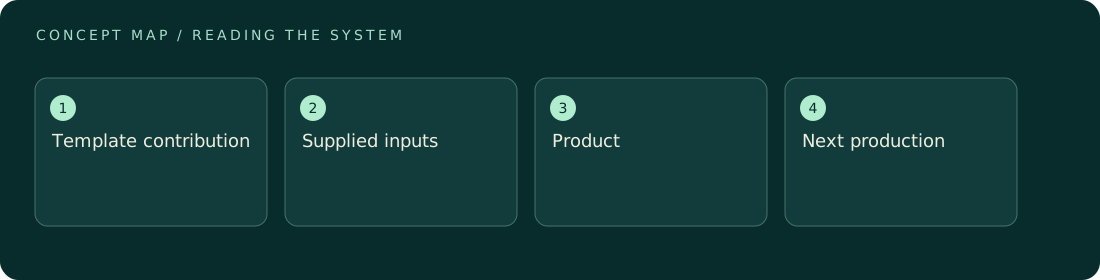
ILLUSTRATIVE · NOT A REPORTED RESULT
An example to work through
Imagine a fictional drawing machine that reads a card and prints one matching card. If a person must manually redesign the machine after every print, the process differs from a setup in which printed cards can become the next inputs without redesign. Assume both yield a visually identical first copy. The first result alone cannot tell a learner which production relationship exists. A lineage diagram would make the distinction clearer. This analogy contains no biological components and makes no claim that the machine is alive; it isolates the question of whether products can participate in repeated copying.
Where interpretation fails
Do not interpret self-replication as freedom from all external resources or researcher-defined conditions. Also avoid using one successful copy as evidence of indefinite repetition. A study may establish a bounded process under a supplied environment while leaving robustness, heredity, and broader cellular functions unresolved.
The next decision
Ask what makes the next copy, what inputs are supplied, and whether newly produced entities participate in later production. Keep information fidelity separate from growth rate. State the demonstrated number or scope of production events accurately, and do not expand molecular replication into a claim about complete life.
Sources & context
These sources support the concepts noted below. Our synthetic examples and research framing are educational interpretation; they are not findings from these organizations or validation of our ventures.
- Self-sustained Replication of an RNA Enzyme ↗
The original RNA-enzyme study reports self-sustained replication under experimental conditions; no protocol is reproduced.
Source check: Research search excerpts reviewed; full-text page blocked by challenge.
Educational research context, not a validated device specification or clinical protocol. Read our editorial and correction policy.