
The essential answer
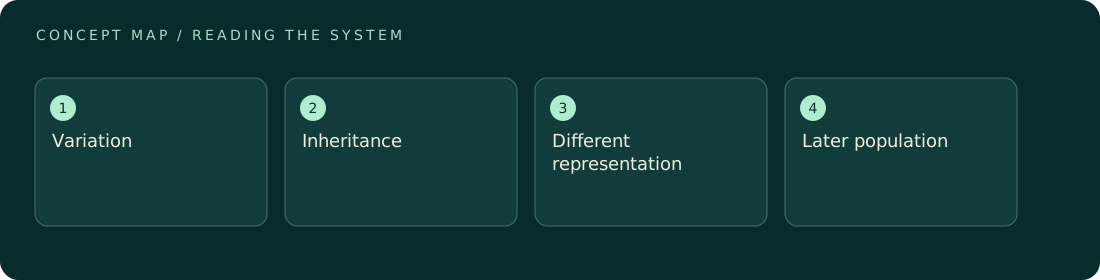
Variation means that entities differ. Heritable variation means that relevant differences can persist through reproduction or a comparable lineage process. For Darwinian evolution, differences also need consequences for representation across generations. A temporary response shared by every entity is not the same thing as an inherited difference. The cited RNA-network research investigates relationships among growth and variation. Its relevance here is that these properties must be examined together, rather than treating any diversity or change as sufficient evidence of evolution.
How to reason about it
A population can look different at two times for many reasons. Its environment may have changed, its members may have been selected differently for observation, or its inherited composition may have shifted. These explanations require different evidence. A lineage perspective asks whether descendants resemble their predecessors in the relevant property and whether that relationship helps explain later representation. It also avoids assuming that evolution means improvement according to a human goal. A trait can become more common under one set of conditions without being universally better. In a conceptual model, the inheritance rule and the relationship between a trait and persistence should be explicit. Otherwise, a graph showing changing proportions may look evolutionary while leaving the crucial causal connections unspecified.
ILLUSTRATIVE · NOT A REPORTED RESULT
An example to work through
Assume a toy population contains equal numbers of square and round tokens. A rule lets each square token contribute two descendants and each round token one, with shape inherited exactly. Starting from four of each, the next generation contains eight squares and four rounds: squares rise from one half to two thirds of the total. This arithmetic follows the invented rule. If descendant shape were instead assigned randomly, the inheritance argument would change. The example is not a biological experiment and does not imply that real evolution follows a fixed or perfectly faithful reproduction rule.
Where interpretation fails
Do not call every change adaptation. A shift can reflect temporary conditions, sampling, or chance rather than inherited differences with consequences. Also avoid assuming that heredity must be perfect; the relevant question is whether enough structured continuity exists for lineage-dependent effects to be evaluated.
The next decision
When assessing an evolution claim, identify variation, inheritance, and differential representation as separate evidence requirements. Ask how alternative explanations were considered. State the environmental context and avoid progress language unless an explicit, relevant performance measure has been defined and actually supported by the observations.
Sources & context
These sources support the concepts noted below. Our synthetic examples and research framing are educational interpretation; they are not findings from these organizations or validation of our ventures.
- Darwinian properties and their trade-offs in autocatalytic RNA reaction networks ↗
The research examines Darwinian properties and trade-offs in autocatalytic RNA networks.
Source check: Research page opened; abstract and introduction excerpts reviewed.
Educational research context, not a validated device specification or clinical protocol. Read our editorial and correction policy.