

The essential answer
An effective-medium model replaces a structured material with averaged parameters that reproduce selected behavior within a stated regime. It can be very useful, but the parameters are not automatically universal properties valid for every wavelength, geometry, or excitation. Unit-cell scale, resonances, boundaries, anisotropy, and spatial dispersion can matter. A successful fit to one transmission experiment does not guarantee correct predictions for near fields or forces. State what observable the effective model reproduces and compare it with explicit-structure calculations or independent measurements when extending its use.
How to reason about it
The motivation for homogenization is to simplify a complicated microstructure into a response at a larger scale. A separation between structural and field-variation scales often helps, but no single ratio guarantees validity for all systems. Resonant inclusions can create strong local variations even when a structure looks small relative to a free-space wavelength. Effective permittivity or permeability may depend on direction and frequency, and some situations require wavevector-dependent or nonlocal descriptions. The retrieval method can also introduce ambiguities when extracting parameters from finite-slab scattering. Validate the model for the intended observable: propagation through a thick sample, reflection at an interface, and interaction across a tiny gap can probe different aspects of the structure. A careful presentation distinguishes an engineered response of the complete patterned object from a bulk constitutive description that can safely be transferred to another geometry.
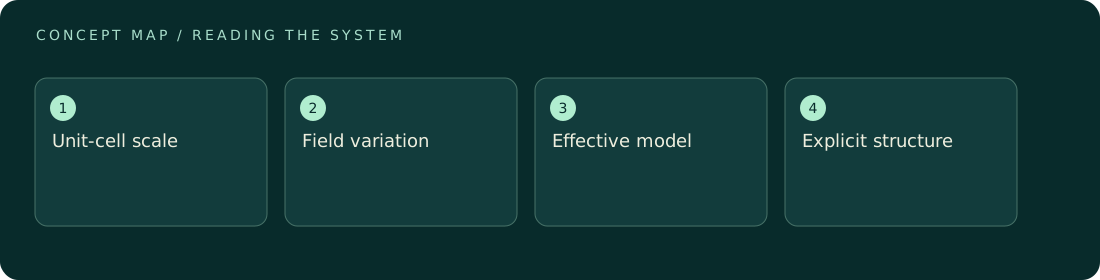
ILLUSTRATIVE · NOT A REPORTED RESULT
An example to work through
Assume a hypothetical periodic structure has a 1 mm unit-cell pitch. At a free-space wavelength of 100 mm, the ratio is 0.01; at 5 mm it is 0.2. The first condition offers a stronger scale separation, but neither ratio alone proves a particular effective model. If an application probes a 0.1 mm gap near the surface, local structure can matter even in the first wavelength case. These dimensions are invented to compare scales. They do not establish a validated threshold, a measured refractive index, or a predicted force for any actual metamaterial.
Where interpretation fails
A retrieved negative parameter is not permission to ignore loss, bandwidth, or boundary conditions. Effective parameters obtained from one sample thickness may also depend on the retrieval model. Avoid transferring far-field fitted constants directly into near-field or Casimir calculations without checking the relevant spatial scales.
The next decision
Use homogenization when it reproduces the observables and regimes needed for the task. Document unit-cell geometry and scale ratios, then compare against explicit microstructure for sensitive predictions. If transferability fails, describe the patterned device directly rather than forcing it into a universal bulk-material label.
Sources & context
These sources support the concepts noted below. Our synthetic examples and research framing are educational interpretation; they are not findings from these organizations or validation of our ventures.
- Generalized effective-medium theory for metamaterials ↗
Primary model with stated dipole and geometry assumptions illustrates that effective parameters depend on a model.
Source check: Primary preprint abstract opened and reviewed; full paper not reviewed.
Educational research context, not a validated device specification or clinical protocol. Read our editorial and correction policy.