

The essential answer
Hysteresis means the measured response depends on the path taken through input conditions. Loading and unloading can therefore give different outputs at the same instantaneous input. A loop may reflect switching, friction, plasticity, delayed relaxation, thermal drift, or the measurement system. Its meaning depends on the conjugate variables and protocol. In a mechanical stress-strain cycle, the loop integral gives work per volume over that cycle under the relevant assumptions. The presence of a loop alone does not establish durable memory or a novel mechanism.
How to reason about it
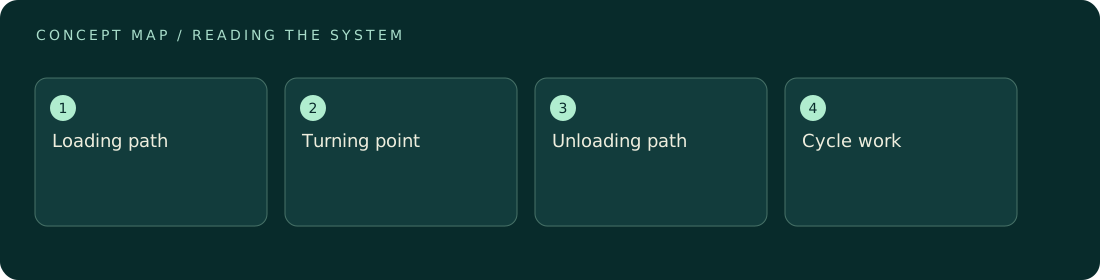
Record the starting state, sweep rate, turning points, dwell intervals, and number of prior cycles. These define the history that a hysteretic sample experiences. Compare rates and include holds at selected inputs to separate persistent path dependence from a response that merely lags. Check instrument dynamics with a reference specimen or independent sensor when feasible. The area enclosed by a plot has physical meaning only when the axes form the appropriate work pair: stress with strain, force with displacement, or another correctly defined conjugate pair. An arbitrary output-versus-control loop is not automatically an energy measurement. Repeated cycling can change the loop through training, damage, or temperature rise. Show this evolution rather than averaging it away if it bears on the claim. A useful interpretation connects a reproducible loop feature to a specific prediction about history, timescale, or dissipation.
ILLUSTRATIVE · NOT A REPORTED RESULT
An example to work through
Assume a hypothetical uniform specimen has a measured stress-strain loop integral of 2,000 Pa, with strain dimensionless. That equals 2,000 J/m³ of mechanical work per cycle. For a specimen volume of 1 cm³, or 0.000001 m³, the corresponding work is 0.002 J per cycle. At one cycle per second, a steady identical loop would imply 0.002 W of average mechanical input. These assumptions exclude changing specimen volume and evolving loops; the calculation does not establish where the energy goes or whether the observed loop is intrinsic to the material.
Where interpretation fails
A loop plotted against an instrument command may include actuator lag or compliance rather than sample behavior. A loop area in arbitrary units also cannot be called dissipated energy. Identify the actual measured input and output, their calibration, and their relation to mechanical or electrical work.
The next decision
Report loop shape together with rate and preparation history. Use hold tests and repeat cycles to determine whether the effect persists or relaxes. Make an energy claim only with appropriate conjugate variables and a calibrated integral; make a memory claim only with a separate retention protocol.
Sources & context
These sources support the concepts noted below. Our synthetic examples and research framing are educational interpretation; they are not findings from these organizations or validation of our ventures.
- Hysteresis and Related Error Mechanisms in the NIST Watt Balance Experiment ↗
Primary metrology paper illustrating hysteresis as a measurement concern; original teaching examples do not summarize its results.
Source check: Official PDF bibliographic/search excerpt reviewed.
Educational research context, not a validated device specification or clinical protocol. Read our editorial and correction policy.