

The essential answer
Material memory means that a past intervention leaves a state that can later be distinguished under a defined read protocol. Slow drift can produce history-dependent readings without a controllable stored state. To separate them, specify writing, waiting, reading, and erasing operations, then test retention and reproducibility. The read operation should be characterized because it may itself alter the state. A loop or delayed response is a starting observation, not sufficient evidence of a useful memory element with a defined retention time.
How to reason about it
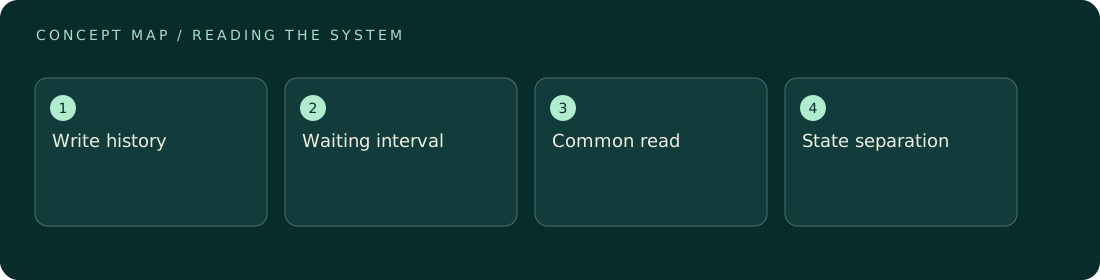
Construct histories that end at the same external conditions but differ in a deliberate earlier input. After a specified wait, apply the same read procedure and compare the resulting distributions across repetitions. Include an unwritten control exposed to the same elapsed time and environment. If all samples drift together, the apparent separation may reflect timing rather than stored information. Vary the waiting time to measure retention instead of assuming that a short-lived difference persists indefinitely. Test whether erasure returns the system to a reproducible baseline and whether repeated writes cause fatigue. Define the discrimination rule before examining the final data when practical. A useful memory claim concerns the probability of distinguishing states, not merely the difference between two carefully chosen traces. Keep the role of temperature, read amplitude, and device-to-device variation visible throughout this sequence.
ILLUSTRATIVE · NOT A REPORTED RESULT
An example to work through
Assume two invented written states initially read 100 and 120 arbitrary units. After one hour they read 108 and 128, while an unwritten reference has also shifted upward by 8 units. The 20-unit state separation survives this common drift, although an absolute threshold fixed at 110 units may now be poorly positioned. If the states instead converge to 118 and 120 with a read uncertainty of several units, reliable distinction is doubtful. These are diagnostic scenarios, not measured retention results. The interpretation assumes identical read conditions and that the reference tracks the relevant common drift.
Where interpretation fails
Calling any history dependence “memory” obscures whether a state can be intentionally written and reliably read. A destructive read can also make repeated measurements look like decay. Report the read disturbance and separate common environmental drift from loss of separation between the intended states.
The next decision
Require a complete write-wait-read sequence and a matched time control. Quantify state separation relative to variability at each wait duration. If only short-term history dependence is established, use that description and leave long-term retention, cycling endurance, and reliable information storage as untested properties.
Sources & context
These sources support the concepts noted below. Our synthetic examples and research framing are educational interpretation; they are not findings from these organizations or validation of our ventures.
- Stateful characterization of resistive switching TiO2 — NIST research notice ↗
Links primary resistive-switching characterization work; memory diagnostics here are original proposed tests.
Source check: Official research notice/search excerpt and paper citation reviewed.
Educational research context, not a validated device specification or clinical protocol. Read our editorial and correction policy.