

The essential answer
Blinding prevents knowledge of the expected outcome from influencing analysis choices. In a small-force experiment, an independent person or locked procedure can hide condition labels, reverse signs, or insert known test signals while analysts develop the pipeline. The goal is to expose unconscious tuning and verify recovery under realistic conditions. Blinding does not repair a poor physical model or eliminate instrumental artifacts. Combine it with independent controls, predeclared acceptance criteria, and a clear record of what was hidden and when it was revealed.
How to reason about it
Choose a blind that protects the decisions most vulnerable to expectation. If analysts can infer the condition from temperature channels, merely renaming files offers weak protection. A hidden scale or offset can preserve diagnostic structure while concealing the final result, although it must not make calibration impossible. Reserve an independent set of injections or controls after analysis choices are frozen. Document exclusions using criteria that do not depend on the desired sign or amplitude. Keep enough unblinded engineering data to diagnose malfunction without exposing the final contrast. Once the blind is opened, report any subsequent changes and treat them as a new analysis rather than pretending they were planned. Blinded recovery tests should include null cases as well as nonzero signals, because a pipeline can recover strong injections while still generating false positives near its threshold.
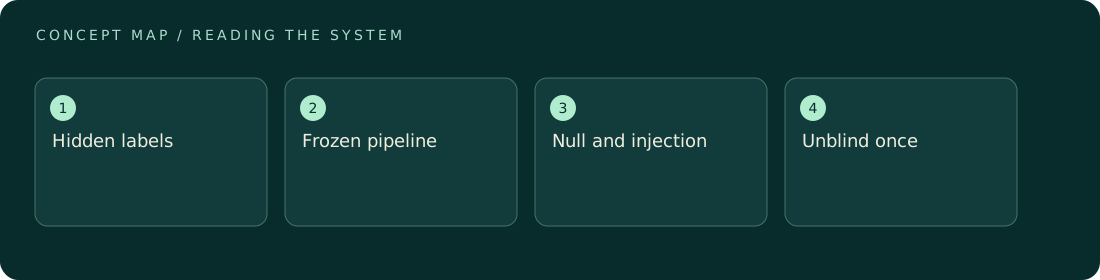
ILLUSTRATIVE · NOT A REPORTED RESULT
An example to work through
Imagine ten illustrative records with hidden injected forces: five are zero and five contain 2 nN. Analysts freeze a linear reconstruction and an uncertainty model before receiving the key. If the nonzero group averages 1.9 nN with comparison uncertainty 0.2 nN, recovery is compatible with the injection. If the null group averages 0.8 nN with the same uncertainty, the pipeline has a concerning offset despite successful nonzero recovery. These hypothetical results would motivate a new investigation, not selective reporting of the successful injection group as validation.
Where interpretation fails
Do not repeatedly open partial blinds until the result looks satisfactory. That converts a confirmatory test into iterative tuning. A blind also fails if filenames, timestamps, acquisition lengths, or auxiliary channels reveal the hidden condition; audit those side channels before relying on the protection.
The next decision
Use blinding when substantial judgment enters filtering, data exclusion, or model selection. Freeze the relevant decisions and test recovery across null and nonzero cases. After unblinding, preserve the original outcome and clearly label revised analyses; obtain a fresh independent test before making a stronger confirmation claim.
Sources & context
These sources support the concepts noted below. Our synthetic examples and research framing are educational interpretation; they are not findings from these organizations or validation of our ventures.
- LIGO: Blind injection stress-tests searches ↗
Example of blind experimental testing; collaboration account opened.
Source check: Relevant excerpt or resource metadata checked; see support note. Original illustrative calculation, not source data.
Educational research context, not a validated device specification or clinical protocol. Read our editorial and correction policy.