

The essential answer
Parameter identifiability asks whether the available observations can distinguish one parameter value from alternatives. A model may fit well while many parameter combinations make nearly identical predictions. Structural nonidentifiability arises from the mathematical observation problem even with ideal data; practical nonidentifiability reflects limited or noisy information in the actual experiment. Examine parameter tradeoffs rather than trusting a single optimizer output. If the decision depends on a particular parameter, determine whether that parameter is constrained separately or only through a combination with others.
How to reason about it
Begin with the measurement equation and ask which combinations of unknowns enter the observed response. Algebra can sometimes reveal an exact symmetry: multiplying one parameter and dividing another may leave every prediction unchanged. For nonlinear problems, explore the fit while fixing one parameter at different values and allowing others to adjust. A broad range of equally acceptable fits indicates that a precise point estimate would be misleading. Bounds imposed by the analyst can make an interval appear finite without adding information from the data, so distinguish physical knowledge from arbitrary numerical restrictions. Additional measurements should target the ambiguity directly. Measuring a new observable, changing the excitation, or extending the observation window can be more useful than simply repeating the original condition. Predictions may remain well determined even when individual parameters are not, which is why identifiability must be evaluated in relation to the intended inference.
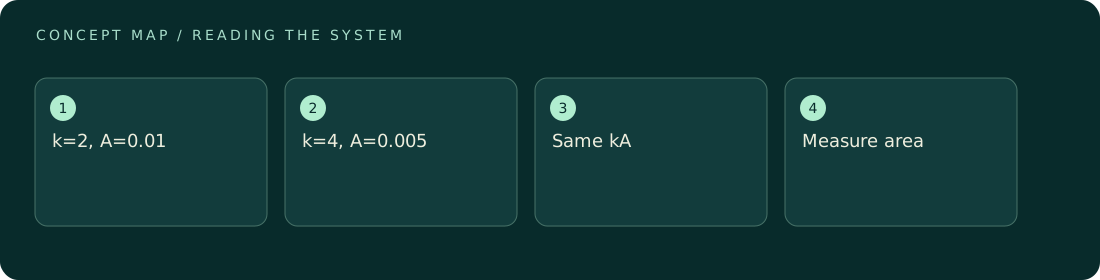
ILLUSTRATIVE · NOT A REPORTED RESULT
An example to work through
Suppose a steady thermal experiment observes only heat rate Q = k A deltaT/L. Assume L and deltaT are known but both conductivity k and effective area A are unknown. If the measured relationship requires kA = 0.02 W m/K, then k = 2 with A = 0.01 square metres and k = 4 with A = 0.005 square metres give identical predictions. Repeating the same temperature difference more accurately cannot separate the pair. An independent area measurement would break this particular ambiguity. This deliberately simple case illustrates structural information loss, rather than a failure of the fitting software or insufficient numerical precision.
Where interpretation fails
An optimizer reporting successful convergence means it found a solution to its numerical task, not that nature uniquely selected the returned parameters. Small local standard errors can also be misleading when the acceptable parameter region is curved, bounded, multimodal, or far from the approximation used to compute them.
The next decision
If the fitted quantity drives a scientific claim, check whether alternative parameter combinations fit equally well before reporting it. When only a product or ratio is supported, report that combination. Collect a measurement that breaks the relevant ambiguity if separate values are necessary for transfer to a new condition.
Sources & context
These sources support the concepts noted below. Our synthetic examples and research framing are educational interpretation; they are not findings from these organizations or validation of our ventures.
- Raue et al.: Structural and practical identifiability ↗
Profile likelihood can expose parameter nonidentifiability.
Source check: Publisher search abstract inspected; full text open failed.
Educational research context, not a validated device specification or clinical protocol. Read our editorial and correction policy.