
The essential answer
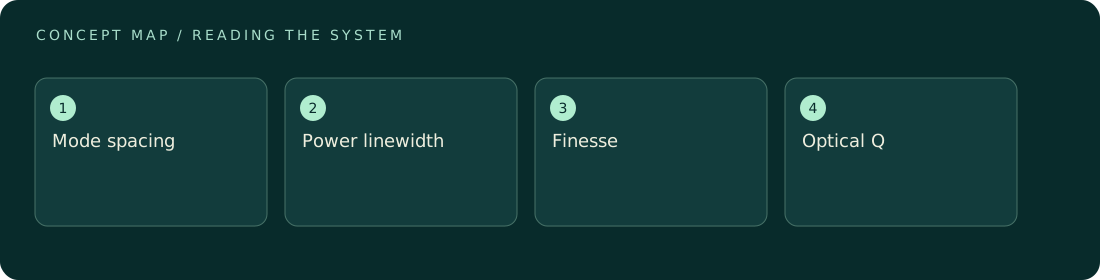
Finesse is free spectral range divided by resonance linewidth. Quality factor Q is resonance frequency divided by linewidth, using consistent frequency and width conventions. They describe related but different aspects of a resonator: finesse indicates how sharply adjacent modes are separated, while Q measures storage relative to an optical cycle. Two cavities can have equal finesse and different Q because their mode spacings differ. Neither quantity alone determines input coupling, absorbed power, mode volume, or useful force sensitivity.
How to reason about it
For a simple empty linear cavity of length L, the free spectral range is c/(2L). In a dispersive cavity, the relevant round-trip group delay modifies that expression. Specify whether linewidth is the full width at half maximum of power and whether Q is loaded, intrinsic, or coupling limited. Loaded linewidth includes all loss channels seen in operation, while intrinsic Q excludes external coupling losses. For exponential energy decay with lifetime τ, Q = ω0τ under the energy-lifetime convention; field amplitude decays with a different time constant. A cavity scan can be distorted by laser frequency noise, thermal motion, or scan speed, so its apparent width may not equal the passive resonance width. Compare linewidth and ringdown measurements when possible. Use finesse for mode-selectivity questions, Q for energy-storage timescale questions, and separate coupling parameters when calculating actual buildup.
ILLUSTRATIVE · NOT A REPORTED RESULT
An example to work through
Assume a hypothetical cavity has free spectral range 1 GHz, optical resonance frequency 200 THz, and power linewidth 10 MHz. Finesse is 1,000/10 = 100. Q is 200×10¹²/(10×10⁶) = 2×10⁷. The energy lifetime is Q/(2πf0) = 1/(2π×10 MHz) ≈ 15.9 ns. A second cavity with the same linewidth and optical frequency but a 2 GHz free spectral range has the same Q and twice the finesse. The distinction follows directly from the different numerators. All linewidths here are power full widths at half maximum.
Where interpretation fails
Do not exchange field-amplitude decay time and energy decay time; that creates a factor-of-two error. Avoid quoting an unloaded theoretical Q alongside a loaded measured linewidth without explaining coupling. A narrow observed feature can also be an interference effect rather than a single isolated cavity resonance.
The next decision
Choose the metric according to the question, and publish linewidth, center frequency, and free spectral range whenever possible so readers can reconstruct both. For buildup or heating predictions, include external coupling and internal loss separately. Confirm that linewidth measurement conditions do not broaden or thermally distort the resonance.
Sources & context
These sources support the concepts noted below. Our synthetic examples and research framing are educational interpretation; they are not findings from these organizations or validation of our ventures.
- Thorlabs: Fabry–Perot Interferometer Tutorial ↗
Manufacturer search excerpt on finesse and linewidth checked; PDF open returned no extractable text.
Source check: Relevant excerpt checked; original illustrative calculation, not source data.
Educational research context, not a validated device specification or clinical protocol. Read our editorial and correction policy.