
The essential answer
Autocatalysis means that a product contributes to catalyzing its own formation, directly or through a network. This creates a form of positive feedback, but it does not imply unlimited growth or a complete living system. The cited research analyzes how growth depends on reaction properties and external conditions. For a learner, the key distinction is between a feedback relationship and the many further claims sometimes attached to it, such as autonomous maintenance, heredity, or inevitable evolutionary success.
How to reason about it
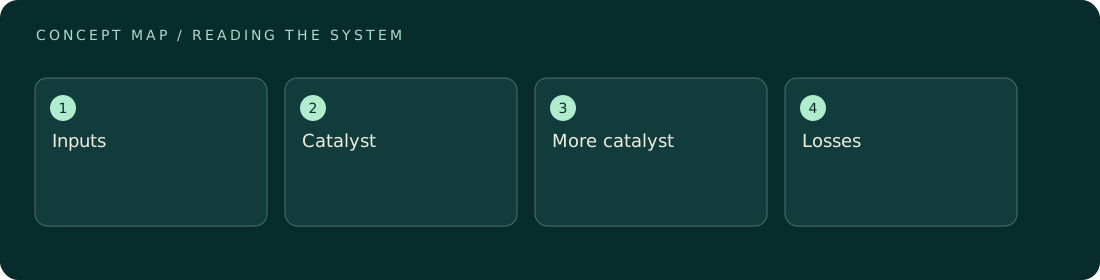
A feedback arrow can make a diagram look self-sufficient even when the system still depends on inputs and favorable conditions. To interpret the diagram, identify what the arrow represents and what it leaves out. More catalyst may increase a process under some assumptions, but resources, inhibition, and loss can change the resulting behavior. The cited modeling work is especially useful as a reminder that a growth law is conditional. Our teaching inference is to avoid reading one arrow as a complete prediction. The graph of abundance over time must follow from stated assumptions, and different assumptions can produce different graphs. This is a conceptual account of model interpretation, not guidance for selecting chemicals, setting conditions, or constructing an autocatalytic experiment.
ILLUSTRATIVE · NOT A REPORTED RESULT
An example to work through
Assume an invented token model starts with four tokens. During each round, every token is credited with one additional token, but only while an unlimited reserve is assumed. The first two rounds produce totals of eight and sixteen. Now replace the unlimited reserve with only six spare tokens. The same rule cannot continue indefinitely: after distributing six additions, the total reaches ten and the reserve is empty. The arithmetic illustrates why a positive feedback rule does not remove resource assumptions. Tokens are not molecules, and these numbers do not predict any real reaction rate or yield.
Where interpretation fails
Do not equate autocatalysis with perpetual motion or automatic Darwinian evolution. A feedback relationship says neither where resources originate nor whether meaningful differences can be inherited. Also avoid assuming that the fastest-growing isolated system will dominate under every set of environmental conditions.
The next decision
Read an autocatalytic claim by separating the feedback mechanism, resource assumptions, loss processes, and observed growth. Ask which of these were measured and which were modeled. Treat any claim about heredity or evolution as an additional question requiring its own evidence, rather than a consequence of the label.
Sources & context
These sources support the concepts noted below. Our synthetic examples and research framing are educational interpretation; they are not findings from these organizations or validation of our ventures.
- Design principles, growth laws, and competition of minimal autocatalysts ↗
The research analyzes conditional growth laws, inhibition, and competition of autocatalysts.
Source check: Research full-text page opened; abstract and discussion excerpts reviewed.
Educational research context, not a validated device specification or clinical protocol. Read our editorial and correction policy.