

The essential answer
Migration converts content into a different representation so it can remain usable as technology changes. Success means more than producing a file that opens: the properties important to the intended use must remain interpretable. Library of Congress sustainability guidance considers formats, dependencies, and significant content characteristics. A conversion can preserve one property while changing another. The useful question is therefore which properties matter for this object, and what evidence shows that the new representation retains them.
How to reason about it
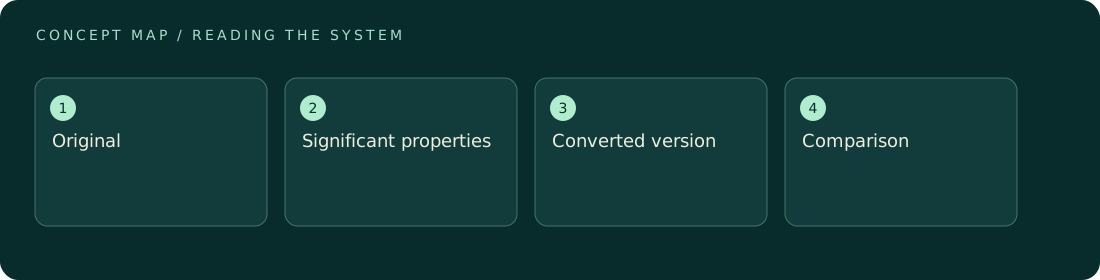
Different users may depend on different aspects of the same object. A reader might need the visible text of a report; a researcher might need its tables as structured data; an accessibility user might depend on reading order and descriptions. A migration judged only by visual resemblance could miss these differences. The teaching framework is to define significant properties before comparing representations. Then document the relationship between the original and converted versions, including known losses or uncertainties. Retaining the original can provide a reference, but keeping it does not remove the need to assess the conversion. Likewise, selecting a widely supported format helps with one kind of risk without proving that every feature transferred correctly. Preservation is a continuing interpretive responsibility, not a one-time filename change.
ILLUSTRATIVE · NOT A REPORTED RESULT
An example to work through
Imagine a hypothetical interactive chart converted into a static image. Assume the picture faithfully preserves the visible line, but the original also allowed users to inspect individual values. For a poster, the image might meet the intended use. For a study requiring exact values, it does not preserve the necessary function by itself. A separate data table could address that need if its relationship to the image is documented. The example shows why migration quality cannot be reduced to one universal score. It is an original scenario, not an assessment of a particular application.
Where interpretation fails
Do not equate a new extension with a completed migration. A file can open while losing structure, annotations, accessibility information, or behavior. Conversely, a changed appearance need not mean the important information was lost. Evaluate the properties that were explicitly selected for preservation.
The next decision
Name the intended users and significant properties before assessing a converted file. Compare those properties, document the transformation, and keep unresolved losses visible. Treat a successful conversion as evidence for its tested purposes, not as a permanent guarantee against all future software or interpretation problems.
Sources & context
These sources support the concepts noted below. Our synthetic examples and research framing are educational interpretation; they are not findings from these organizations or validation of our ventures.
- Sustainability Factors ↗
LOC discusses migration, external dependencies, and significant content characteristics.
Source check: Official guidance opened; sustainability factors reviewed.
Educational research context, not a validated device specification or clinical protocol. Read our editorial and correction policy.