

The essential answer
Metadata supplies context that helps people identify, interpret, and manage an object. A file can retain every byte yet lose much of its practical meaning if its definitions and relationships disappear. NIST's archival research highlights descriptive metadata as necessary for future access in its engineering-data setting. The broader teaching inference is that preservation includes the information needed to understand an object, not merely the object in isolation. Which context matters depends on the intended future use.
How to reason about it
Consider a table whose columns are labeled only A, B, and C. Its numbers may be legible, but a future reader cannot safely infer units, measurement meaning, or the relationship among rows. Context is not decoration added after the important content; in this case it determines what the content says. Other objects need different context: an image may require its date and provenance, while a model may require an explanation of assumptions. Good metadata also distinguishes known facts from uncertain or inferred descriptions. More fields are not automatically better if their meanings are unclear or their associations are wrong. The educational aim is to identify the minimum context needed for a particular interpretation, and then ask whether that context will remain connected to the object.
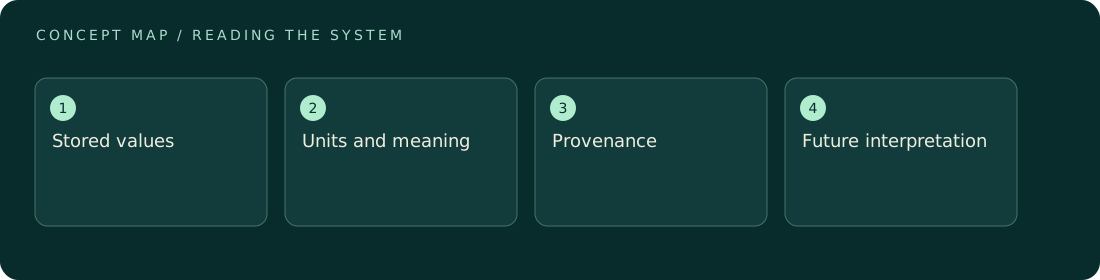
ILLUSTRATIVE · NOT A REPORTED RESULT
An example to work through
Assume a fictional file contains the sequence 10, 20, 30. One description calls these distances; another calls them elapsed times. The bytes alone cannot settle the difference. Now add that the values are distances in meters measured at three named locations, with an explicit note that the dates are unknown. The file becomes more interpretable while the uncertainty remains visible. This example adds no real measurement data. It demonstrates why a candid incomplete description can be more useful than a confident but invented one, and why units belong with the data they qualify.
Where interpretation fails
Avoid assuming that a descriptive filename can replace a durable explanation. Filenames may be abbreviated, ambiguous, or changed during transfer. Also avoid filling missing fields with plausible guesses. Undocumented assumptions can look like original facts once the people who made them are no longer available.
The next decision
Ask a future-reader question: what would someone need to understand this object without contacting its creator? Preserve those definitions and relationships alongside it. Mark uncertainty explicitly, and verify that context still points to the correct object after copying, migration, or reorganization of the collection.
Sources & context
These sources support the concepts noted below. Our synthetic examples and research framing are educational interpretation; they are not findings from these organizations or validation of our ventures.
- Descriptive Metadata Requirements for Long-term Archival of Digital Product Models ↗
The NIST research abstract explains descriptive metadata requirements for future archival access.
Source check: Research publication abstract opened; paper not reviewed in full.
Educational research context, not a validated device specification or clinical protocol. Read our editorial and correction policy.