
The essential answer
Maintainability is the ability to restore or preserve required function through feasible maintenance actions under stated conditions. It depends on access, fault diagnosis, replacement procedures, tools, spares, and the people doing the work. A component that rarely fails can still create unacceptable downtime if its repair requires dismantling the whole system. Treat maintenance as an operational scenario during design, with measurable tasks and recovery criteria. Demonstrate that the proposed intervention works in the intended setting rather than assuming assembly convenience guarantees serviceability.
How to reason about it
Map likely service tasks and follow the physical and informational steps needed to complete each one. Can the failed item be identified without replacing several good parts? Can it be reached with available tools? Are connectors distinguishable, fasteners accessible, and calibration steps documented? Consider hazards and contamination introduced by opening the system, along with the checks needed before return to service. Maintenance time should include diagnosis, access, logistics, replacement, reassembly, and verification, with waiting time distinguished where useful. Evaluate tasks using representative personnel rather than only the designer, whose familiarity can hide procedural gaps. Design choices that improve access may add mass or cost, so compare them against expected operational burden. Preserve lessons from trial maintenance in the design record and update instructions whenever hardware or software changes alter the recovery procedure.
ILLUSTRATIVE · NOT A REPORTED RESULT
An example to work through
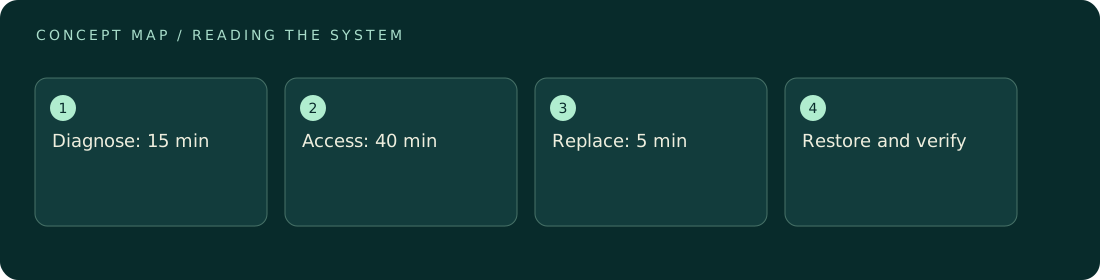
Imagine a fictional instrument whose replaceable fan takes five minutes to swap once exposed. In the current enclosure, shutdown takes ten minutes, diagnosis fifteen, disassembly forty, reassembly twenty, and functional verification ten. Total active restoration time is 100 minutes, not five. A revised access panel reduces disassembly to ten minutes and reassembly to five, producing a 55-minute total under the same assumptions. The 45-minute saving is meaningful only if the panel preserves required sealing and structural behavior. This worked task decomposition shows why a part replacement time alone is a poor description of maintainability.
Where interpretation fails
Designers often underestimate maintenance because they know hidden fasteners, undocumented reset sequences, and which connector belongs where. A successful bench repair by the creator does not demonstrate field serviceability. Omitting recalibration or post-maintenance verification can also make a quick repair appear successful while leaving the system outside its requirements.
The next decision
Before freezing the design, rehearse consequential maintenance tasks with representative tools, access constraints, and personnel. Measure the full restoration sequence and identify dominant delays. Adopt changes that reduce operational burden without undermining other requirements, then verify that the maintained system returns to its accepted configuration and performance.
Sources & context
These sources support the concepts noted below. Our synthetic examples and research framing are educational interpretation; they are not findings from these organizations or validation of our ventures.
- NASA: Crosscutting Technical Management ↗
Technical planning, configuration, and assessment coordinate engineering decisions.
Source check: Official handbook HTML opened; management overview inspected.
Educational research context, not a validated device specification or clinical protocol. Read our editorial and correction policy.