
The essential answer
If 100 illustrative compartments divide into 200 while total cargo stays at 1000 molecules, mean cargo falls from 10 to 5 molecules per compartment. The compartment count doubled, but no cargo replication occurred. Repeated division without replenishment would dilute the average further. Physical multiplication of boundaries is an important observable, yet it is not equivalent to copying internal information or maintaining a viable lineage through successive divisions.
How to reason about it
Keep separate ledgers for compartment number, total cargo, and the distribution of cargo among compartments. Conservation of cargo during ideal division fixes the total but allows uneven partitioning. A mean alone can hide empty compartments, especially when copy numbers become small. Molecule synthesis could maintain average loading as compartments multiply, but synthesis by itself does not establish faithful copying of a sequence. The official laboratory excerpt frames membrane and RNA replication as distinct components of a larger goal. The calculation below makes that distinction quantitative with invented integer counts. It ignores cargo degradation, fusion, exchange, unequal compartment sizes, and correlations in partitioning; each would alter the interpretation of a real observation and would need explicit characterization.
ILLUSTRATIVE · NOT A REPORTED RESULT
An example to work through
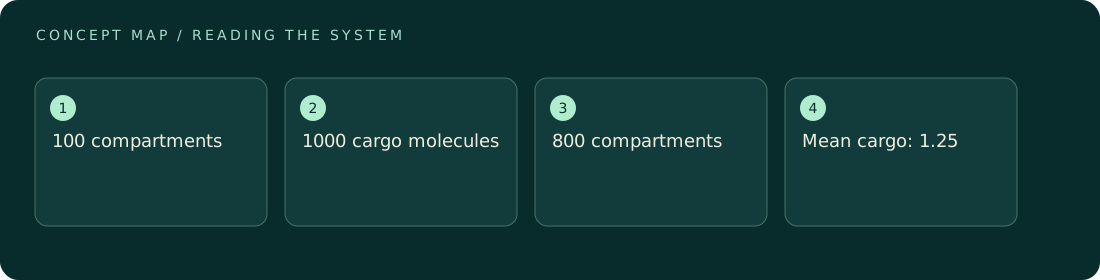
Start with an illustrative population of 100 compartments containing 1000 total cargo molecules, so the mean loading is 1000/100=10. After one ideal division of every compartment, there are 200 and the mean is 1000/200=5 if total cargo is conserved. After three rounds, count is 100×2³=800 and mean is 1000/800=1.25. Maintaining the original mean of 10 would require 8000 total molecules, an addition of 7000. For a separate Poisson occupancy approximation with mean 1.25, the probability that a compartment is empty is exp(−1.25)=0.286505. Among 800 compartments, the expected empty count is approximately 229.2. This last estimate assumes independent random allocation and is not an exact consequence of division from initially loaded parents. A lineage-based partition model could yield another distribution. The distinction matters: the average loading follows the mass balance, but the empty fraction needs an additional stochastic model.
Where interpretation fails
Counting newly visible objects can confuse division with fragmentation, de-aggregation, or a changed detection threshold. Likewise, multiplying a mean cargo value by a count is valid only when sampling represents the population. An occupancy model should not be treated as a measured distribution simply because it matches the mean.
The next decision
Report compartment counts and total cargo independently, then inspect loading distributions and lineage continuity. For this example, division is supported by the assumed count history but cargo replication is absent by construction. Any claim of coupled replication would need evidence that cargo increases and preserves the relevant informational properties.
Sources & context
These sources support the concepts noted below. Our synthetic examples and research framing are educational interpretation; they are not findings from these organizations or validation of our ventures.
- Szostak Lab: Replicating Vesicles ↗
Membrane growth and division are distinct from replication of contained RNA.
Source check: Official laboratory search excerpt reviewed; direct page fetch failed
Educational research context, not a validated device specification or clinical protocol. Read our editorial and correction policy.