
The essential answer
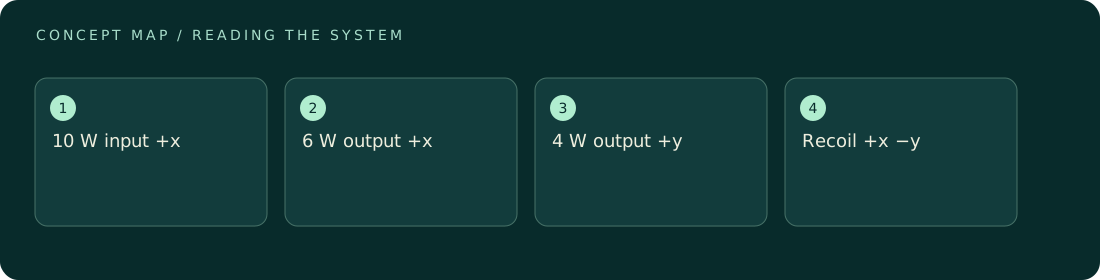
For the illustrative lossless splitter, 10 watts enter along positive x while 6 watts leave along positive x and 4 watts leave along positive y. The object's force is proportional to the vector difference between incoming and outgoing momentum flux: (4,−4)/c newtons. Its magnitude is 18.9 nanonewtons, directed 45 degrees below positive x. Conservation of optical energy does not imply zero force because momentum also has direction.
How to reason about it
Choose a control surface enclosing the splitter and track every optical beam crossing it. In vacuum, a collimated beam of power P carries momentum flux P/c along its propagation direction. The steady force on the enclosed object equals incoming vector flux minus outgoing vector flux when other momentum transfers are absent. An optical element can redirect light without absorbing it, exchanging momentum while leaving the total outgoing power unchanged. The common expression P/c is not a universal force magnitude; it applies directly to a normally absorbing beam under suitable assumptions. Here each outgoing direction matters. Mechanical supports would balance the calculated force in a static apparatus. Thermal radiation, light scattered outside the listed beams, and propagation in a material would need additional care in a more complete analysis.
ILLUSTRATIVE · NOT A REPORTED RESULT
An example to work through
Use illustrative powers Pin=10 W, Pout,x=6 W, and Pout,y=4 W. The energy check is 10−6−4=0 W, so this idealized object stores no optical energy. With c=299792458 m/s, incoming momentum flux is (10/c,0) N and outgoing flux is (6/c,4/c) N. Subtracting gives Fx=4/c=1.33426×10⁻⁸ N and Fy=−4/c=−1.33426×10⁻⁸ N. Multiplying by 10⁹ converts each component to ±13.3426 nN. The magnitude is sqrt(Fx²+Fy²)=sqrt(32)/c=1.88692×10⁻⁸ N, or 18.8692 nN. The angle is atan2(−4,4)=−45 degrees. As a counterexample, let both outputs instead travel along positive x with their same powers. Their combined outgoing vector becomes (10/c,0), and the net force becomes zero. Identical powers thus support different force predictions when beam geometry changes. This is an idealized bookkeeping problem, not an apparatus performance claim.
Where interpretation fails
Subtracting total outgoing power from incoming power would predict zero force and miss the transverse recoil. Conversely, adding beam force magnitudes would ignore cancellation. A diagram should label propagation arrows, not merely beam paths, because reversing an outgoing direction changes the sign of its momentum contribution.
The next decision
Before comparing a measured force with this prediction, account for all outgoing directions and scattered power. For the example, retain both force components and the resultant rather than reporting only a scalar. A useful check is that a straight-through lossless configuration produces zero force in the same calculation.
Sources & context
These sources support the concepts noted below. Our synthetic examples and research framing are educational interpretation; they are not findings from these organizations or validation of our ventures.
- OpenStax: Momentum and Radiation Pressure ↗
Light transports momentum; the numerical vector balance here is original.
Source check: Official textbook section read
Educational research context, not a validated device specification or clinical protocol. Read our editorial and correction policy.