
The essential answer
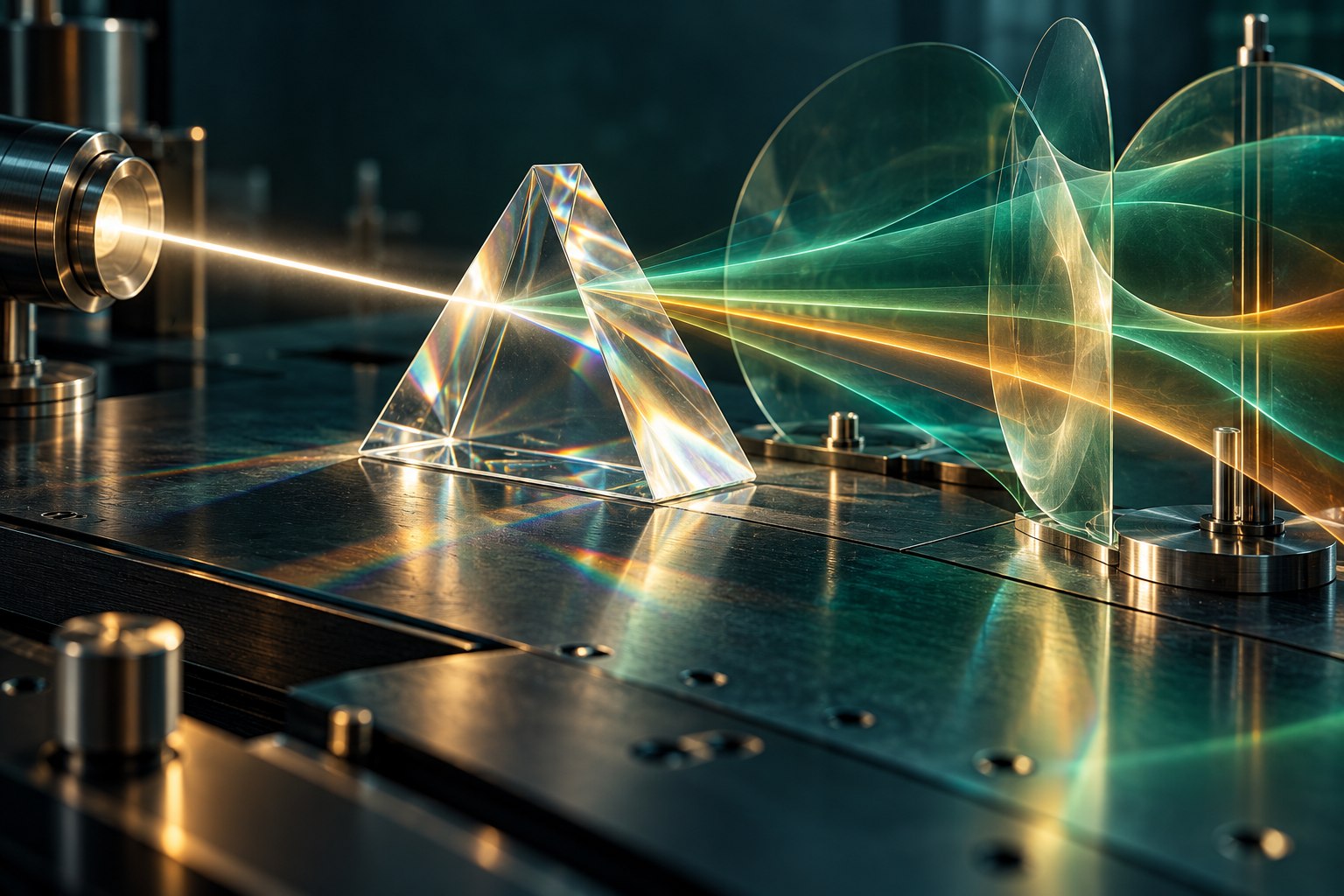
A periodic optical structure sends light into discrete diffraction orders whose directions satisfy phase matching. Each propagating order carries its own power and momentum vector. Force follows from the difference between incident and total outgoing momentum flux, so an asymmetric distribution can produce a lateral load. The grating equation determines allowed directions, not the efficiency in each order. Efficiencies depend on structure, wavelength, polarization, materials, and incidence. Evanescent orders influence near fields but do not behave as freely propagating far-field beams.
How to reason about it
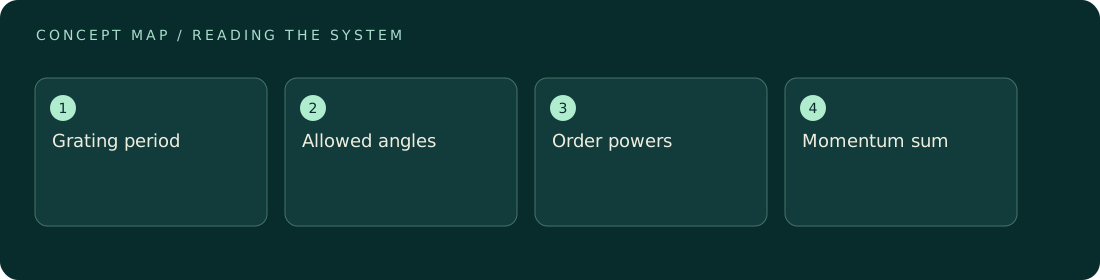
For normal incidence in vacuum on a one-dimensional grating of period d, propagating transmitted orders obey sinθm = mλ/d when a consistent sign convention is used. Only orders with absolute sine no greater than one propagate. Reflection orders require their outgoing normal direction to be treated separately. Energy conservation constrains the sum of all efficiencies plus absorption but does not determine their distribution. A symmetric grating under symmetric illumination often gives symmetric positive and negative orders, canceling lateral momentum; breaking the symmetry can change that balance. Measure enough angular range to collect high-angle orders, which can be missed by a central detector. If the sample is part of a larger optical assembly, include momentum later transferred to beam stops or other optics before assigning net force to the whole assembly. Order-resolved measurements provide a direct consistency check on a claimed lateral force.
ILLUSTRATIVE · NOT A REPORTED RESULT
An example to work through
Assume an illustrative lossless grating with d = 2 µm illuminated normally at λ = 1 µm. First orders emerge at ±30 degrees. Suppose 60% of a 1 W beam exits at +30 degrees and 40% at −30 degrees, with no other orders. Outgoing lateral momentum flux is (0.6−0.4)×sin30°/c = 0.1/c N = 0.333 nN. The grating receives the opposite lateral force. This deliberately simple distribution is an assumed example, not a claimed design efficiency; the normal force also requires the outgoing normal components.
Where interpretation fails
Do not infer order efficiency from the grating equation alone. It specifies directions allowed by periodicity. Nor should power absent from the zero order automatically be called absorption: it may occupy other orders. Missing a weak high-angle order can matter disproportionately for lateral momentum accounting.
The next decision
Use order-resolved power measurements or a validated electromagnetic model when diffraction contributes to force. Check that measured efficiencies close the energy budget within uncertainty and include polarization and wavelength sensitivity. For lateral-force claims, quantify the imbalance between opposite orders and compare its momentum prediction with the force measurement.
Sources & context
These sources support the concepts noted below. Our synthetic examples and research framing are educational interpretation; they are not findings from these organizations or validation of our ventures.
- MIT Optics: Fraunhofer Diffraction ↗
Further reading on diffraction; official resource page checked.
Source check: Relevant excerpt or resource metadata checked; see support note. Original illustrative calculation, not source data.
Educational research context, not a validated device specification or clinical protocol. Read our editorial and correction policy.