
The essential answer
A measurand is the quantity you intend to determine. In a force experiment, “the force” is incomplete: specify the body, axis, time averaging, environmental state, and whether support forces or internal stresses belong in the result. The instrument reports an indication that must be converted into this defined quantity. A precise voltage cannot rescue an ambiguous target. Write the definition before selecting a fitting model, because changing the target after seeing the data can silently change which effects count as signal or correction.
How to reason about it
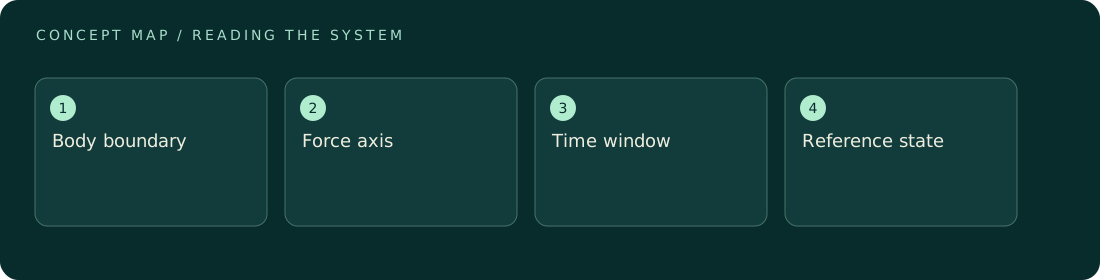
Start with a system boundary and a coordinate frame. A sensor attached to a mount may report the load transmitted through that mount, while the desired quantity is the net external force on the entire assembly. These quantities can differ during acceleration, thermal expansion, or cable motion. Next specify temporal meaning: instantaneous force, steady force after settling, cycle average, or the component at a modulation frequency. Each needs a different estimator. Finally list the state variables held fixed or corrected, such as incident power, orientation, temperature, and pressure. A useful definition contains enough detail that another analyst could select the same data interval and sign convention. If a correction translates the actual operating state into a reference state, its uncertainty belongs with the result. This is a design exercise rather than a claim about any particular apparatus.
ILLUSTRATIVE · NOT A REPORTED RESULT
An example to work through
Illustrative example: define the target as the mean axial external force during the final 20 seconds of each 60-second illumination interval. Assume the first 40 seconds contain a settling transient, the final samples have mean sensor output 12 mV, the contemporaneous dark baseline is 2 mV, and calibration is 2 mV/nN. The defined estimate is (12−2)/2 = 5 nN. Averaging the whole interval could give a different number without contradicting this result, because it would estimate a different temporal quantity. The chosen window must precede inspection of the outcome.
Where interpretation fails
Do not use a broad title such as “propulsion force” as the measurand definition. It embeds a causal interpretation that the sensor alone cannot establish. Report the measured force component and operating conditions first; reserve the mechanism claim for the comparison with explicit competing explanations.
The next decision
Proceed when two people can independently identify the same body, axis, time window, state, and correction convention from the written protocol. If they would integrate different portions of a trace or include different supports, refine the definition before optimizing sensitivity or increasing the number of trials.
Sources & context
These sources support the concepts noted below. Our synthetic examples and research framing are educational interpretation; they are not findings from these organizations or validation of our ventures.
- VIM: measurand ↗
Definition and scope of measurand; opened definition and notes.
Source check: Relevant excerpt or resource metadata checked; see support note. Original illustrative calculation, not source data.
Educational research context, not a validated device specification or clinical protocol. Read our editorial and correction policy.