

The essential answer
A detected signal can come from the target, from contamination, or from an unintended feature of the measurement. Contamination controls help assess these alternatives. NASA research on life-detection missions explicitly connects contamination management with false-positive and false-negative risks. The general lesson is that identifying a molecule or pattern does not automatically establish where it came from. Controls are part of the reasoning behind a claim, not an administrative detail separate from the scientific result.
How to reason about it
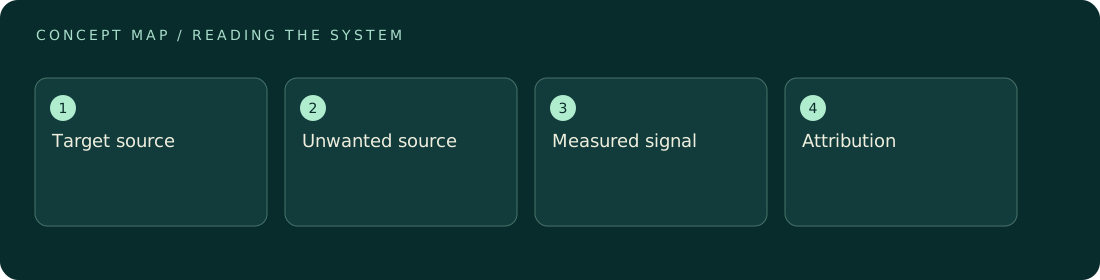
A measurement travels through a chain of contexts: collection, handling, instrumentation, processing, and interpretation. An unwanted contribution introduced along that chain can complicate the relationship between signal and source. A conceptual control asks what the measurement would look like under an alternative explanation. That question is different from demanding that every measurement be perfectly free of background. The relevant issue is whether the competing contributions are understood well enough for the claimed inference. It is also important to consider absence: contamination or interference can obscure a genuine signal as well as imitate one. A careful research account therefore explains what its controls can resolve and what they leave uncertain. This page discusses the logic of controls only, not laboratory procedures or contamination-removal methods.
ILLUSTRATIVE · NOT A REPORTED RESULT
An example to work through
Imagine an invented sensor report with a signal of five arbitrary units in a target reading and four units in a background comparison. Assume the numbers are exact for this simple illustration. Subtracting gives one unit, but the arithmetic alone does not establish a meaningful detection: real interpretation would also require uncertainty and an appropriate comparison. If someone highlights only the five-unit value, the background context disappears. This example deliberately omits experimental methods and represents no instrument. It shows why a detected quantity and an attributed source are distinct claims.
Where interpretation fails
Do not treat a positive result as self-authenticating, or a clean-looking instrument as proof that no unwanted contribution exists. Conversely, finding background does not automatically invalidate every observation. The question is whether the evidence distinguishes the target contribution from plausible alternatives within the stated limits.
The next decision
Ask what alternative sources could produce the reported signal and what comparisons address them. Read control results alongside target results, including uncertainty. Keep source attribution narrower than detection when the evidence cannot separate contributions, and avoid turning a conceptual control discussion into a procedural recipe.
Sources & context
These sources support the concepts noted below. Our synthetic examples and research framing are educational interpretation; they are not findings from these organizations or validation of our ventures.
- Contamination Control for Ultra-Sensitive Life-Detection Missions ↗
NASA research connects contamination control with mitigating false-positive and false-negative life-detection interpretations.
Source check: Official research abstract opened; report not reviewed in full.
Educational research context, not a validated device specification or clinical protocol. Read our editorial and correction policy.