

The essential answer
A testable hypothesis connects assumptions to observations that could support or weaken it. In origins research, showing that a process is possible differs from showing that it happened historically. A strong hypothesis identifies observations that distinguish it from alternatives and acknowledges conditions under which it would fail. NASA's life-detection framework emphasizes ambiguity and false interpretations. The broader lesson is to ask not only what a result is consistent with, but what competing explanations it helps exclude.
How to reason about it
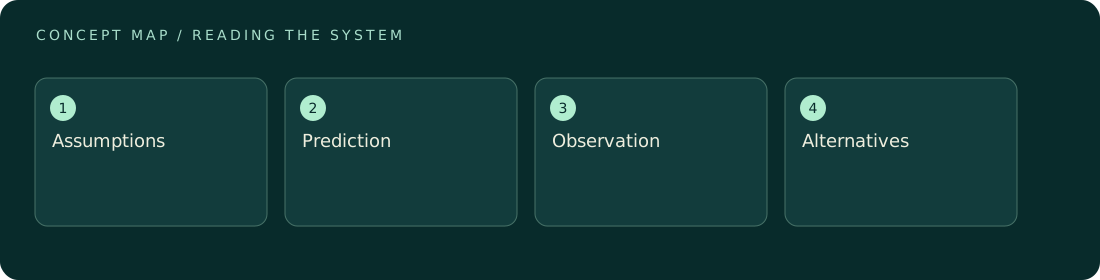
An explanation can fit an observation without being uniquely supported by it. If several hypotheses predict the same result, that result may be interesting while doing little to choose among them. A discriminating prediction instead points to a difference: one model expects a pattern that another does not, under clearly stated conditions. This does not make historical research easy, because evidence can be incomplete and experiments may reproduce only selected aspects of a setting. It does make the argument more transparent. Readers can identify assumptions, predictions, observations, and remaining alternatives as separate parts. A useful hypothesis also states its domain. Failure outside that domain may be irrelevant, whereas failure under its own stated conditions can directly challenge the claim. Revising a hypothesis should make those changes visible.
ILLUSTRATIVE · NOT A REPORTED RESULT
An example to work through
Imagine two fictional origin models. Model A predicts pattern P whenever condition C is present; Model B predicts P whether or not C is present. Observing P under C fits both models and does not distinguish them. An observation outside C could be more informative, provided the models' other assumptions are met. This logical example contains no chemistry or experimental instructions. It illustrates why accumulating compatible examples differs from testing a distinctive prediction, and why a reader should ask which possible result would genuinely make an advocate reconsider the proposed explanation.
Where interpretation fails
Avoid hypotheses that reinterpret every possible outcome as confirmation. Also avoid treating one failed demonstration as disproof of an entire family of ideas when the proposed conditions were not represented. The scope of the prediction and the scope of the evidence must be compared explicitly.
The next decision
Write the hypothesis, its assumptions, a distinctive prediction, and a possible contrary observation. Compare it with at least one alternative explanation. Keep laboratory possibility, environmental plausibility, and historical occurrence separate, and report unresolved alternatives without promoting a preferred scenario into an established account of life's origin.
Sources & context
These sources support the concepts noted below. Our synthetic examples and research framing are educational interpretation; they are not findings from these organizations or validation of our ventures.
- Ladder of Life Detection ↗
NASA framework treats ambiguity and false-positive/false-negative interpretation; hypothesis exercise is original.
Source check: Official framework page opened; false-positive and false-negative definitions reviewed.
Educational research context, not a validated device specification or clinical protocol. Read our editorial and correction policy.