
The essential answer
Growth changes the amount or size of a system; division separates it into parts. These events can be linked, but neither proves the other. A larger object need not divide, and a split need not produce descendants capable of continuing the same behavior. The active-droplet research models conditions under which growth can lead to division. It is a model of particular physical behavior, not proof that every dividing droplet is alive or that the full origin of cells has been explained.
How to reason about it
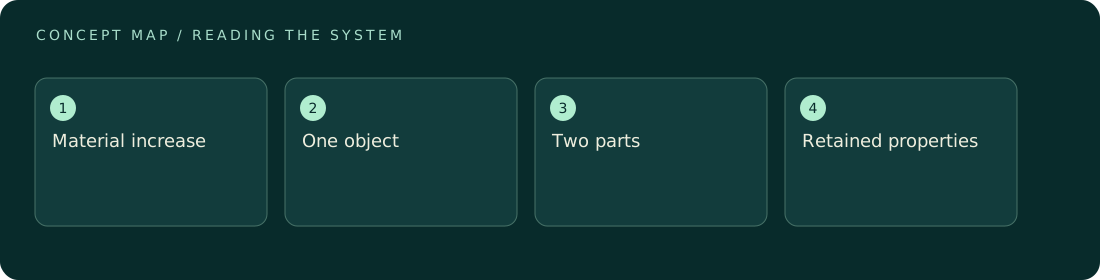
The distinction becomes especially clear when a diagram tracks both material and history. A single circle becoming larger describes one kind of change. A circle becoming two circles describes another. To call those circles descendants in a biologically meaningful argument, a reader needs to know what properties they retain and what happens afterward. Material can be redistributed without recreating a functioning organization. Likewise, a repeated sequence of growth and splitting can remain externally imposed. A useful model specifies which features emerge from its rules and which are supplied as assumptions. The cited work studies a possible physical link between growth and division; our teaching inference is to preserve the distinction between demonstrating that link and establishing the additional properties required for a reproductive lineage.
ILLUSTRATIVE · NOT A REPORTED RESULT
An example to work through
Assume a hypothetical blob has ten material units and splits into parts containing six and four. The total remains ten; division has changed the number of objects without increasing material. In a separate scenario, one blob grows from ten to fifteen units without splitting. Growth has occurred without an increase in object count. Now ask whether either part can repeat the relevant behavior and retain important characteristics. The arithmetic cannot answer that question. These invented units illustrate bookkeeping only and do not represent cells, experimental measurements, or a proposed construction method.
Where interpretation fails
Avoid counting every fragment as a successful offspring. Fragmentation, division, and reproduction can refer to different levels of explanation. Also avoid assuming that equal-sized parts necessarily inherit equivalent properties; the relevant contents and functions may not follow directly from visible size or symmetry.
The next decision
Track material amount, object count, and retained properties separately. Ask whether the observed split connects to continued behavior in descendants. When reading a model, distinguish emergent division from imposed division, and keep a physical demonstration's scope separate from claims about full biological reproduction.
Sources & context
These sources support the concepts noted below. Our synthetic examples and research framing are educational interpretation; they are not findings from these organizations or validation of our ventures.
- Growth and Division of Active Droplets: A Model for Protocells ↗
The original model examines chemically driven growth and division of active droplets.
Source check: Original research preprint abstract opened; model not independently validated.
Educational research context, not a validated device specification or clinical protocol. Read our editorial and correction policy.