

The essential answer
A chain of custody describes responsibility and handoffs over time. It helps a reader understand who held an item and how its recorded history connects across transfers. It is not identical to a quality assessment: a well-documented transfer can describe an item whose suitability remains unknown. NCI's governance framework includes responsible custodianship. The educational aim is to separate continuity of responsibility from continuity of condition, then ask what evidence supports each one rather than treating either as a substitute for the other.
How to reason about it
A transfer has several logically separate aspects. There is an item being transferred, a party releasing it, a party receiving it, and a record connecting the event to the item's history. A gap in that connection limits what later reviewers can reconstruct. But even an uninterrupted chain cannot by itself show whether a particular property survived. For example, a custody record may establish that an item stayed within a known sequence of organizations while saying little about a later scientific measurement. The practical reading skill is to look for the question the record was designed to answer. Responsibility, location, condition, and authorized use may be documented together, but they remain different attributes. Each missing attribute should remain visible rather than inferred from the others.
ILLUSTRATIVE · NOT A REPORTED RESULT
An example to work through
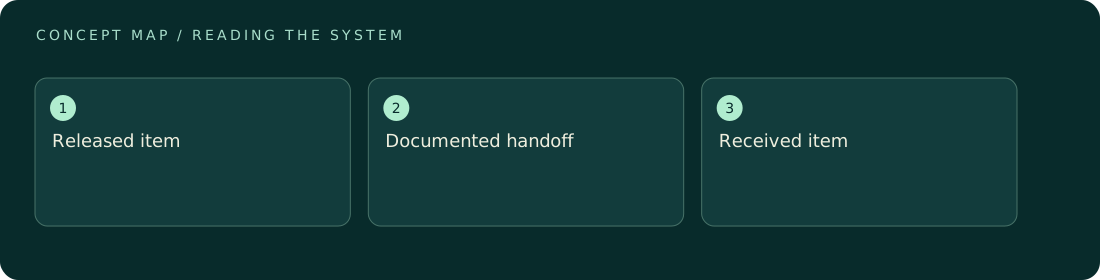
Assume a fictional sample passes from Archive North to Archive South and then to a research collection. The first and third records name the sample consistently, but the middle handoff lacks a receiving acknowledgment. This does not prove that anything harmful happened. It creates a gap in the documented chain. Now assume a separate assessment reports that one measured property is unchanged. That result addresses a property, not the missing handoff. The two findings can coexist: the item may meet one assessment while its custody documentation still needs clarification. No actual collection is described.
Where interpretation fails
Do not equate a missing signature with demonstrated damage, or a complete signature trail with demonstrated suitability. Both shortcuts replace evidence with inference. A custody timeline is strongest when it makes unresolved intervals legible and keeps corrections distinguishable from contemporaneous records of the original transfer.
The next decision
Read custody claims as a timeline of responsibility. Identify gaps, ambiguous item references, and unexplained corrections. Then assess condition and permission separately. If the intended decision depends on an undocumented interval, ask the responsible institution for clarification rather than assuming either continuity or failure.
Sources & context
These sources support the concepts noted below. Our synthetic examples and research framing are educational interpretation; they are not findings from these organizations or validation of our ventures.
- Governance Best Practices ↗
NCI governance includes responsible custodianship; the example and analytical distinctions are original.
Source check: Official governance overview opened; consent alignment and governance scope reviewed, not complete guidance.
Educational research context, not a validated device specification or clinical protocol. Read our editorial and correction policy.