

The essential answer
Viability after storage is an assessment of biological capacity under specified conditions, not a universal label attached forever to a collection. Its meaning depends on the criterion used and the material assessed. A result for a tested portion should not silently become a result for every stored item. NCI emphasizes quality management in biospecimen resources. The conceptual lesson is to ask what was measured, when, and in which sample before deciding what a reported viability result can support.
How to reason about it
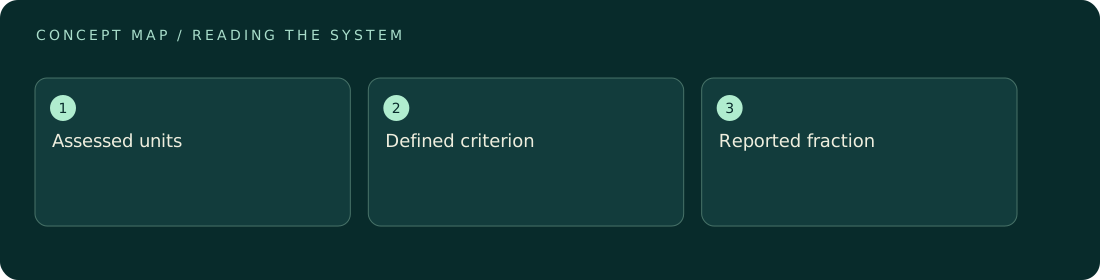
A percentage without a denominator or definition can be surprisingly uninformative. Was the percentage calculated from all assessed units, a selected subset, or only units meeting another condition? What observation counted as success? These questions are mathematical and interpretive, not instructions for a biological assay. They help prevent a summary statistic from concealing selection. Timing matters as well: an observation describes an assessment at a particular point, while a future use may require another judgment. A careful account can report a favorable result and still acknowledge limits. It can also distinguish between different functional questions rather than implying that one assessment captures every relevant property. Suitability is therefore a relationship between the measured evidence and the proposed purpose, not a synonym for a high percentage.
ILLUSTRATIVE · NOT A REPORTED RESULT
An example to work through
Suppose a fictional report assesses 80 units and classifies 60 as meeting its stated criterion. The fraction is 60 divided by 80, or 75 percent. Assume the report does not say how these units were selected from a larger collection. The arithmetic is clear, but representativeness is not. A reader can accurately restate the measured result without saying that 75 percent of the entire collection meets the criterion. If the intended use requires a different property, the statistic also does not answer that question. These invented units are not measurements from an actual specimen.
Where interpretation fails
Do not confuse a precise number with a complete conclusion. Precision in arithmetic cannot repair an unclear definition, an unknown selection process, or a mismatch between the measured property and intended use. Likewise, absence of an assessment should be labeled unknown rather than presumed successful or unsuccessful.
The next decision
Record four items beside a viability claim: assessed material, criterion, denominator, and assessment timing. Then compare that evidence with the proposed application. Seek specialist interpretation for real specimens, and avoid translating a limited viability result into claims about complete function or future biological outcomes.
Sources & context
These sources support the concepts noted below. Our synthetic examples and research framing are educational interpretation; they are not findings from these organizations or validation of our ventures.
- Technical and Operational Best Practices ↗
NCI includes quality management and specimen handling; the statistical interpretation is original.
Source check: Official overview opened; not a review of the complete guidance.
Educational research context, not a validated device specification or clinical protocol. Read our editorial and correction policy.